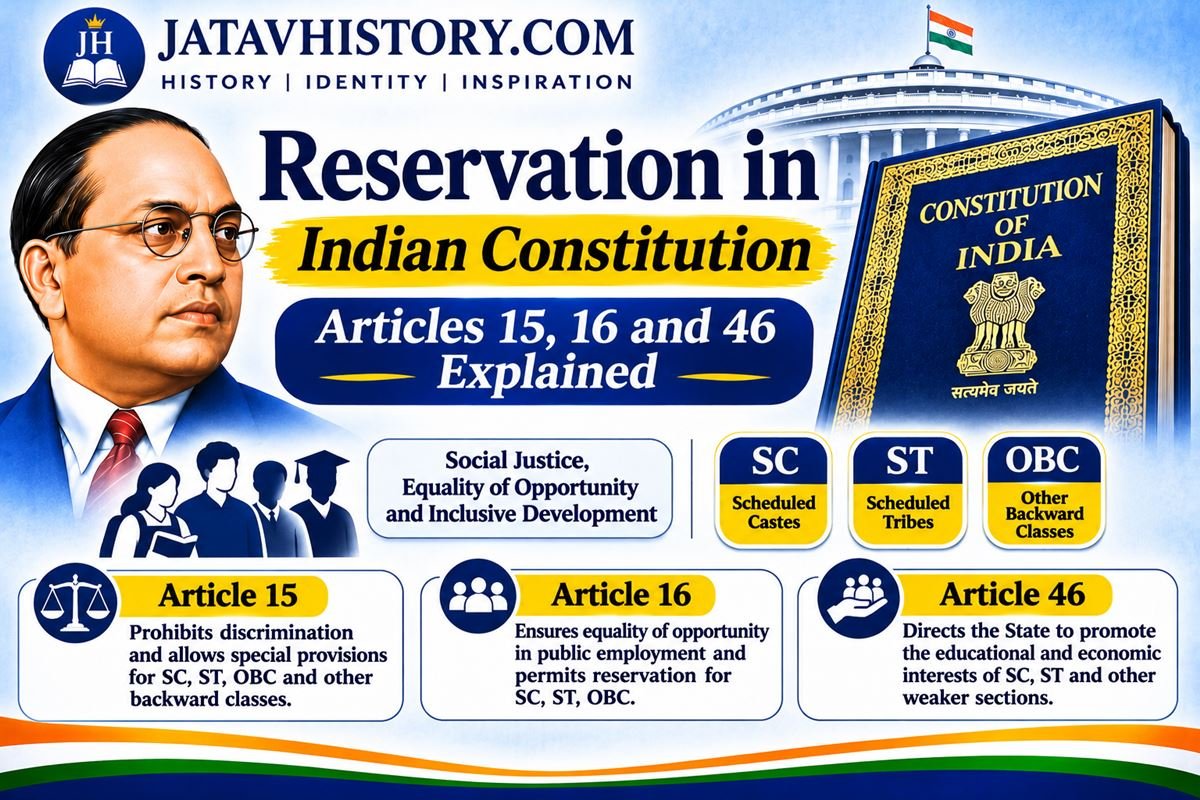
India is a country with people from different social, economic and cultural backgrounds. However, not every community has had the same opportunities in education, employment and public life. For many years, caste-based discrimination and social exclusion prevented several communities from getting equal opportunities.
The Constitution of India recognises this historical inequality. It provides special constitutional provisions to help disadvantaged sections of society move forward and participate equally in national life.
One of the important measures connected with this goal is reservation. It is used in areas such as educational admissions, government employment and elected representative bodies under different constitutional provisions.
Many people search for information about reservation in the Indian Constitution, especially Articles 15, 16 and 46. These Articles explain important parts of the constitutional framework behind special provisions and social justice.
In this article, we will understand the meaning of reservation, its constitutional background, provisions for SC and ST communities, reservation in education and government jobs, EWS reservation and other important facts in simple English.
- Article 15: Prohibition of discrimination and special provisions for specified groups.
- Article 16: Equality of opportunity in public employment and reservation provisions.
- Article 46: Promotion of educational and economic interests of weaker sections, especially SCs and STs.
- Article 15(4): Special provisions for advancement of socially and educationally backward classes, SCs and STs.
- Article 16(4): Reservation in appointments or posts for inadequately represented backward classes.
- 103rd Amendment: Added constitutional provisions for EWS reservation.
What Is Reservation in India?
Reservation is a system of special provisions intended to improve access to opportunities for certain disadvantaged or underrepresented sections of society.
In India, reservation is provided under constitutional provisions and laws made by the Central and State Governments. It can apply to areas such as admission to educational institutions, public employment and representation in elected bodies.
The main purpose is not simply to provide a benefit. It is to address social and educational backwardness, inadequate representation and historical disadvantages that have affected different communities.
Reservation is an important part of India's constitutional approach to equality and social justice. It works alongside other measures such as scholarships, educational support, welfare schemes and legal safeguards.
Why Was Reservation Included in the Indian Constitution?
Before independence, many communities faced social discrimination and restrictions. Access to education, public facilities and government opportunities was not equal for everyone.
Members of several communities were kept away from educational institutions, public employment and other areas of social participation. These disadvantages did not disappear automatically after India became independent.
The makers of the Constitution recognised that equal treatment in law was important, but additional measures were also needed to improve opportunities for communities that had faced long periods of exclusion.
Therefore, the Constitution included provisions allowing the State to make special arrangements for the advancement of socially and educationally backward classes and Scheduled Castes and Scheduled Tribes.
These provisions are connected with the larger constitutional goals of justice, equality and fraternity.
Read more about the values behind these goals in our article: Preamble of the Indian Constitution: Meaning and Importance .
Article 15 – Special Provisions and Reservation in Education
Article 15 is an important provision under Part III of the Constitution. It prohibits discrimination on specified grounds and also allows the State to make certain special provisions.
Article 15 mentions religion, race, caste, sex and place of birth as grounds on which the State cannot discriminate against citizens, subject to the constitutional text and its clauses.
At the same time, Article 15 contains specific clauses that allow special provisions for the advancement of disadvantaged sections.
Article 15(4) – Special Provisions for SC, ST and Backward Classes
Article 15(4) allows the State to make special provisions for the advancement of socially and educationally backward classes of citizens and for Scheduled Castes and Scheduled Tribes.
This provision was added through the Constitution (First Amendment) Act, 1951.
It provides an important constitutional basis for measures such as reservation in educational institutions for the specified groups.
The National Commission for Scheduled Castes also explains that Article 15(4) has enabled reservation for SCs and STs in educational institutions, including technical, engineering and medical colleges.
Article 15(5) – Reservation in Educational Institutions
Article 15(5) allows the State to make special provisions by law for the advancement of socially and educationally backward classes, Scheduled Castes and Scheduled Tribes in matters relating to admission to educational institutions.
It includes private educational institutions, whether aided or unaided by the State, but excludes minority educational institutions referred to in Article 30(1).
This clause was inserted through the Constitution (Ninety-third Amendment) Act, 2005.
Article 15(6) – EWS Reservation in Education
Article 15(6) was added through the Constitution (103rd Amendment) Act, 2019.
It allows special provisions for the advancement of economically weaker sections of citizens who are not covered by the classes mentioned in Article 15(4) and Article 15(5).
The provision also allows reservation for EWS in educational institutions, including private educational institutions, other than minority educational institutions under Article 30(1).
For reservation under this clause, the Constitution provides for a maximum of ten per cent of the total seats in each category.
- 15(1) – Prohibition of discrimination by the State on specified grounds.
- 15(2) – Protection against certain forms of discrimination in access to public places and facilities.
- 15(3) – Special provisions for women and children.
- 15(4) – Special provisions for socially and educationally backward classes, SCs and STs.
- 15(5) – Special provisions relating to admission in educational institutions.
- 15(6) – Special provisions for EWS, including educational admission reservation.
Article 16 – Reservation in Government Jobs
Article 16 deals with equality of opportunity in matters of public employment. It is an important constitutional provision for people applying for government jobs and public posts.
Article 16(1) provides equality of opportunity for all citizens in matters relating to employment or appointment to an office under the State.
Article 16(2) prohibits discrimination in public employment on specified grounds, including religion, race, caste, sex, descent, place of birth or residence.
The following clauses provide the constitutional framework for certain forms of reservation.
Article 16(4) – Reservation in Public Employment
Article 16(4) allows the State to make provisions for reservation of appointments or posts in favour of any backward class of citizens that, in the opinion of the State, is not adequately represented in services under the State.
This clause is an important constitutional basis for reservation in government employment.
The decision to provide reservation under this provision must follow the relevant constitutional requirements and applicable legal principles.
Article 16(4A) – Reservation in Promotion for SC and ST
Article 16(4A) allows the State to make provisions for reservation in matters of promotion, with consequential seniority, in favour of Scheduled Castes and Scheduled Tribes where the State considers them inadequately represented in services under it.
This provision was added through the Constitution (Seventy-seventh Amendment) Act, 1995.
It is important to understand that Article 16(4A) is an enabling provision. It does not automatically create an identical promotion reservation arrangement in every department or State.
Article 16(4B) – Carry Forward of Reserved Vacancies
Article 16(4B) deals with unfilled reserved vacancies of a particular year that are carried forward to be filled in succeeding years.
It allows these carried-forward vacancies to be treated as a separate class for determining the ceiling on reservations for vacancies of the year in which they are filled.
Article 16(6) – EWS Reservation in Government Jobs
Article 16(6) was added through the 103rd Constitutional Amendment Act, 2019.
It allows reservation in appointments or posts in favour of economically weaker sections of citizens who are not covered by the classes mentioned in Article 16(4).
The Constitution permits this EWS reservation to be up to ten per cent of the posts in each category.
- 16(1) – Equality of opportunity in public employment.
- 16(2) – Prohibition of discrimination in public employment on specified grounds.
- 16(4) – Reservation for inadequately represented backward classes.
- 16(4A) – Reservation in promotion for SCs and STs under specified conditions.
- 16(4B) – Treatment of carried-forward reserved vacancies.
- 16(6) – EWS reservation in public employment.
Article 46 – Promotion of Educational and Economic Interests
Article 46 is part of Part IV of the Constitution, which contains the Directive Principles of State Policy.
It directs the State to promote, with special care, the educational and economic interests of the weaker sections of society, especially the Scheduled Castes and Scheduled Tribes.
Article 46 also directs the State to protect these groups from social injustice and all forms of exploitation.
This Article is important because it expresses the constitutional responsibility of the State to improve educational and economic opportunities for disadvantaged communities.
Unlike Fundamental Rights, Directive Principles are not directly enforceable by courts. However, Article 37 says that they are fundamental in the governance of the country and it is the duty of the State to apply them in making laws.
Reservation for SC and ST Communities
Scheduled Castes and Scheduled Tribes have faced different forms of social exclusion and disadvantage over many generations.
The Constitution therefore provides several safeguards to support their participation in education, public employment and political representation.
Some important provisions include:
- Article 15(4) – Special provisions for the advancement of SCs and STs.
- Article 15(5) – Special provisions relating to admission in educational institutions.
- Article 16(4) – Reservation in appointments or posts for inadequately represented backward classes.
- Article 16(4A) – Reservation in promotion for SCs and STs under specified conditions.
- Article 46 – Promotion of educational and economic interests of SCs and STs.
- Article 330 – Reservation of seats for SCs and STs in the Lok Sabha.
- Article 332 – Reservation of seats for SCs and STs in State Legislative Assemblies.
These provisions cover different areas. For example, Articles 15 and 16 concern special provisions and public employment, while Articles 330 and 332 concern political representation.
Read our related article: Constitutional Safeguards for SC and ST Communities in India .
Reservation in Education
Education is an important way to improve opportunities and social participation. Constitutional provisions allow special measures for specified disadvantaged groups in educational institutions.
Article 15(4) and Article 15(5) are particularly important in this area.
Depending on the applicable central or state rules, reservation may be provided in admissions to different educational institutions.
These measures can help students from disadvantaged communities access higher education and professional courses.
Reservation rules can differ between institutions, states, central institutions and admission systems. Students should always check the official admission notification for the relevant academic year.
Reservation in Government Jobs
Reservation in government jobs is connected mainly with Article 16. It is intended to improve representation of specified communities in public services.
The applicable reservation rules can depend on whether a recruitment is conducted by the Central Government or a State Government. The rules may also depend on the service, post and recruitment notification.
Candidates should carefully check the official recruitment advertisement for category-wise vacancies, eligibility conditions, age relaxation, application requirements and required certificates.
What Is EWS Reservation in India?
EWS means Economically Weaker Sections. The Constitution (103rd Amendment) Act, 2019 introduced Articles 15(6) and 16(6) to provide a constitutional basis for special provisions for EWS.
These provisions allow up to ten per cent reservation for eligible EWS candidates in educational admissions and public employment, subject to the conditions stated in the Constitution and applicable rules.
EWS reservation is distinct from the reservation provisions for SCs, STs and other backward classes under other clauses.
Eligibility criteria and certificate requirements are determined under the applicable government rules. Candidates should check the latest official notification before applying.
What Is the 50% Reservation Ceiling?
The 50% reservation principle is often discussed in relation to reservation in India. It is associated with the Supreme Court's judgment in the Indra Sawhney case decided in 1992.
In that case, the Supreme Court discussed the general ceiling on reservation under Articles 15(4) and 16(4), while recognising that exceptional situations may require separate consideration.
The constitutional position later developed through amendments and court judgments. For example, the 103rd Constitutional Amendment introduced separate EWS provisions under Articles 15(6) and 16(6).
In November 2022, the Supreme Court upheld the constitutional validity of the 103rd Amendment by a 3:2 majority in Janhit Abhiyan v. Union of India.
Therefore, it is not accurate to explain the 50% principle as a simple rule that applies identically to every category and every reservation arrangement. Its application depends on the relevant constitutional provision and judicial decisions.
Important Constitutional Amendments Related to Reservation
Reservation-related provisions have developed through several constitutional amendments. Some important amendments are listed below.
| Amendment | Year | Important Change |
|---|---|---|
| First Amendment | 1951 | Added Article 15(4), allowing special provisions for backward classes, SCs and STs. |
| 77th Amendment | 1995 | Added Article 16(4A), relating to reservation in promotion for SCs and STs. |
| 81st Amendment | 2000 | Added Article 16(4B), relating to carried-forward reserved vacancies. |
| 82nd Amendment | 2000 | Added a proviso to Article 335 concerning relaxation in qualifying marks and standards for SC/ST promotion reservation. |
| 85th Amendment | 2001 | Provided for consequential seniority in certain promotion reservation matters under Article 16(4A). |
| 93rd Amendment | 2005 | Added Article 15(5), concerning special provisions for admission in educational institutions. |
| 103rd Amendment | 2019 | Added Articles 15(6) and 16(6) for EWS special provisions. |
Difference Between Articles 15, 16 and 46
Articles 15, 16 and 46 are closely connected with equality and social justice, but their purposes are different.
| Point | Article 15 | Article 16 | Article 46 |
|---|---|---|---|
| Part | Part III | Part III | Part IV |
| Main subject | Discrimination and special provisions | Equality in public employment | Educational and economic advancement |
| Important area | Education and access to public facilities | Government jobs and promotion provisions | Welfare and protection of weaker sections |
| Nature | Fundamental Right provision | Fundamental Right provision | Directive Principle |
Role of Dr. B. R. Ambedkar in Social Justice and Equality
Dr. B. R. Ambedkar was one of the most important leaders in the struggle against caste discrimination and social inequality. He believed that political democracy must be supported by social and economic equality.
As Chairman of the Drafting Committee, he played a leading role in the preparation of the Constitution of India. The Constitution included provisions aimed at protecting equality, dignity and the rights of disadvantaged groups.
Ambedkar's work and ideas remain important in discussions about representation, social justice, education and equal opportunities.
Read our detailed article: Dr. B. R. Ambedkar's Role in Making the Indian Constitution .
Why Is Reservation Important for Social Justice?
Social justice means creating a society where people can enjoy equal dignity, rights and opportunities.
Historical discrimination can affect access to education, employment and public institutions for generations. Reservation is one of the constitutional measures used to improve representation and opportunities for specified groups.
It is also important to understand that reservation is only one part of a wider approach. Quality education, healthcare, economic support, legal protection and equal treatment are also necessary for social development.
The larger aim is to build a society where a person's background does not become a barrier to education, employment or dignity.
Frequently Asked Questions About Reservation in India
1. Which Articles of the Indian Constitution provide for reservation?
Articles 15 and 16 contain important provisions for special measures and reservation. Article 46 directs the State to promote the educational and economic interests of weaker sections, especially Scheduled Castes and Scheduled Tribes.
2. What is Article 15(4)?
Article 15(4) allows the State to make special provisions for the advancement of socially and educationally backward classes and for Scheduled Castes and Scheduled Tribes.
3. What is Article 16(4)?
Article 16(4) allows the State to provide reservation in appointments or posts for a backward class of citizens that is not adequately represented in services under the State.
4. What is Article 46 of the Indian Constitution?
Article 46 directs the State to promote the educational and economic interests of weaker sections, particularly SCs and STs, and protect them from social injustice and exploitation.
5. Which Article provides reservation in education?
Article 15(4) and Article 15(5) are important constitutional provisions for special measures relating to educational advancement and admissions.
6. Which Article provides reservation in government jobs?
Article 16(4) provides the constitutional basis for reservation in public employment for inadequately represented backward classes.
7. Is there reservation in promotion for SC and ST employees?
Article 16(4A) allows the State to make provisions for reservation in promotion, with consequential seniority, for SCs and STs under specified constitutional conditions.
8. What is EWS reservation?
EWS reservation refers to special provisions for eligible economically weaker sections under Articles 15(6) and 16(6), inserted by the 103rd Constitutional Amendment.
9. What is the 50% reservation rule?
The 50% principle is associated with the Supreme Court's Indra Sawhney judgment concerning reservation under Articles 15(4) and 16(4). Its application depends on the relevant constitutional provisions and judicial decisions.
10. Which amendment introduced EWS reservation?
The Constitution (103rd Amendment) Act, 2019 introduced Articles 15(6) and 16(6), providing a constitutional basis for EWS reservation.
11. Is Article 46 a Fundamental Right?
No. Article 46 is a Directive Principle of State Policy under Part IV of the Indian Constitution.
12. Does the Constitution provide reservation in Parliament?
Yes. Article 330 provides reservation of seats for Scheduled Castes and Scheduled Tribes in the Lok Sabha, while Article 332 provides reservation in State Legislative Assemblies.
Conclusion
Reservation is an important part of India's constitutional framework for social justice and equal opportunity. It aims to improve access to education, public employment and representation for specified disadvantaged groups.
Article 15 deals with non-discrimination and special provisions, Article 16 addresses equality in public employment, and Article 46 directs the State to promote the educational and economic interests of weaker sections, particularly SCs and STs.
These provisions show that the Constitution does not treat equality only as identical treatment in every situation. It also recognises the need for measures that address historical and social disadvantages.
Understanding reservation requires reading the relevant constitutional clauses, amendments and court judgments. Awareness of these provisions helps citizens understand their rights and the constitutional principles behind social justice in India.
Official Sources and Further Reading
- Constitution of India – Part III, Articles 15 and 16
- National Commission for Scheduled Castes – Constitutional Safeguards
- National Commission for Scheduled Tribes – Constitutional Provisions
- Press Information Bureau – Government of India Reservation Policy
- Supreme Court – Janhit Abhiyan Judgment on EWS Reservation
- Legislative Department – Constitution of India
Explore More About the Indian Constitution
Continue reading our Constitution series to understand important constitutional Articles and safeguards.
- Constitution Day: History and Importance of 26 November
- Dr. B. R. Ambedkar's Role in Making the Indian Constitution
- Preamble of the Indian Constitution
- Article 17: Abolition of Untouchability
- Six Fundamental Rights in India
- Article 341: Recognition of Scheduled Castes
- Constitutional Safeguards for SC and ST Communities
- How Was the Indian Constitution Written?
- Constitution Day Speech and Essay in English