The Constitution of India is the foundation of the country's democratic system. It explains how the government works, defines the powers of different institutions and protects the rights of citizens.
But have you ever wondered how the Indian Constitution was written? Who prepared it? How many people took part in the process? And why is Dr. B. R. Ambedkar remembered as one of the most important figures in its making?
The Constitution was not written by one person in a few days. It was the result of a long process involving hundreds of representatives, committees, legal experts and detailed discussions in the Constituent Assembly.
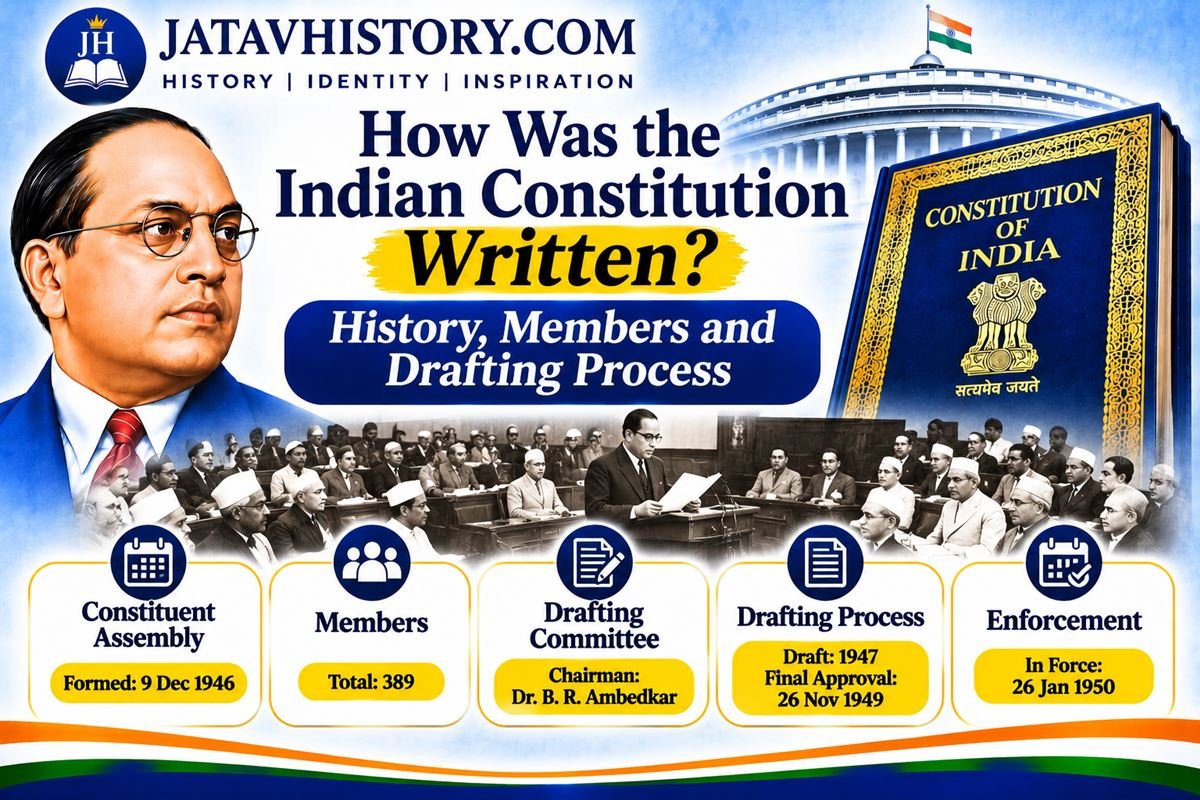
The Assembly first met on 9 December 1946. After years of discussion and drafting, it adopted the Constitution on 26 November 1949. The Constitution came into force on 26 January 1950.
In this article, we will understand the complete history of the making of the Indian Constitution, the important members, the Drafting Committee and the contribution of Dr. B. R. Ambedkar.
- First meeting: 9 December 1946
- Constituent Assembly President: Dr. Rajendra Prasad
- Drafting Committee formed: 29 August 1947
- Drafting Committee Chairman: Dr. B. R. Ambedkar
- Draft Constitution introduced: 4 November 1948
- Constitution adopted: 26 November 1949
- Members signed the Constitution: 24 January 1950
- Constitution came into force: 26 January 1950
- Time taken: 2 years, 11 months and 17 days
How Did the Process of Making the Indian Constitution Begin?
The demand for a Constitution made by Indians developed during the freedom movement. Many Indian leaders believed that the people of India should decide how their country would be governed after independence.
The idea of a Constituent Assembly became an important part of this demand. Such an Assembly would include representatives who could discuss and prepare the framework for independent India.
In 1946, the British Government sent the Cabinet Mission to India. Its plan provided for the formation of a Constituent Assembly to prepare the Constitution.
The members were mainly elected indirectly by members of the Provincial Legislative Assemblies. Representatives of princely states were also part of the proposed arrangement.
This process created the Constituent Assembly of India, which later became responsible for preparing the Constitution.
When Was the Constituent Assembly Formed?
The Constituent Assembly was formed under the Cabinet Mission Plan of 1946.
Its first meeting was held on 9 December 1946 in New Delhi. The meeting took place in the Constitution Hall, which is now known as the Central Hall of Parliament House.
Dr. Sachchidananda Sinha served as the temporary Chairman of the first meeting. Later, on 11 December 1946, Dr. Rajendra Prasad was elected as the permanent President of the Constituent Assembly.
The Assembly began its work before India became independent. After independence in August 1947, it continued its work as a sovereign body responsible for making the Constitution.
Who Were the Members of the Constituent Assembly?
The Constituent Assembly originally had a proposed strength of 389 members. This included representatives from British Indian provinces and princely states.
After the Partition of India in 1947, the membership of the Assembly was reduced to 299.
These members represented different regions, communities, professions and political backgrounds. They discussed important questions about democracy, citizenship, rights, government and the future of the country.
Some well-known members included:
- Dr. Rajendra Prasad
- Dr. B. R. Ambedkar
- Jawaharlal Nehru
- Sardar Vallabhbhai Patel
- Maulana Abul Kalam Azad
- Alladi Krishnaswami Ayyar
- K. M. Munshi
- Hansa Mehta
- Durgabai Deshmukh
- Rajkumari Amrit Kaur
- Sarojini Naidu
- Sucheta Kripalani
The Assembly also included women members who participated in discussions on equality, education, rights and other important constitutional issues.
According to official parliamentary information, there were 15 women members in the Constituent Assembly.
What Was the Role of the Constituent Assembly?
The main responsibility of the Constituent Assembly was to prepare a Constitution for independent India.
Its members had to discuss many important questions, including:
- What type of government should India have?
- What rights should citizens receive?
- How should the powers of the government be divided?
- How should Parliament and State Governments work?
- How should minorities and disadvantaged communities be protected?
- How should the judiciary function?
- What should be the relationship between the Union and States?
- How should elections and representation work?
The members studied constitutional systems from different countries and discussed which ideas could be suitable for India.
They also considered India's history, diversity, social conditions and the needs of a newly independent country.
What Was the Objectives Resolution?
On 13 December 1946, Jawaharlal Nehru moved the Objectives Resolution in the Constituent Assembly.
This resolution explained the basic goals and principles that would guide the making of the Constitution.
It included ideas such as sovereignty, democracy, justice, equality and protection of people's rights.
The Assembly adopted the Objectives Resolution on 22 January 1947. It later became an important foundation for the Preamble of the Indian Constitution.
Read more: Preamble of the Indian Constitution: Meaning and Importance .
When Was the Drafting Committee Formed?
The Drafting Committee was established by the Constituent Assembly on 29 August 1947.
Its main responsibility was to examine the available constitutional material, consider the decisions of the Assembly and prepare a Draft Constitution for discussion.
Dr. B. R. Ambedkar was appointed Chairman of the Drafting Committee. He played a leading role in guiding the preparation and presentation of the Draft Constitution.
Who Were the Members of the Drafting Committee?
The Drafting Committee was originally constituted with seven members. Its members included experienced legal experts and public figures.
| No. | Member | Role |
|---|---|---|
| 1 | Dr. B. R. Ambedkar | Chairman |
| 2 | N. Gopalaswami Ayyangar | Member |
| 3 | Alladi Krishnaswami Ayyar | Member |
| 4 | K. M. Munshi | Member |
| 5 | Syed Mohammad Saadulla | Member |
| 6 | B. L. Mitter | Original member; later replaced by N. Madhava Rau |
| 7 | D. P. Khaitan | Original member; after his death, replaced by T. T. Krishnamachari |
Changes in membership took place during the drafting process. B. L. Mitter was replaced by N. Madhava Rau, and after D. P. Khaitan's death, T. T. Krishnamachari joined the Committee.
Why Was Dr. B. R. Ambedkar Made Chairman of the Drafting Committee?
Dr. Bhimrao Ramji Ambedkar was a leading legal thinker, economist, social reformer and political leader. He had a deep understanding of law, constitutional systems and the problems faced by disadvantaged communities.
His knowledge and experience made him an important member of the Constituent Assembly.
On 29 August 1947, he was appointed Chairman of the Drafting Committee. In this role, he helped guide the preparation of the constitutional draft and explain its provisions during Assembly discussions.
The Drafting Committee did not work alone. It considered the work of other committees, constitutional advice, research and decisions made by the Assembly.
Ambedkar's contribution was particularly important in bringing these different elements together into a detailed constitutional document.
His work continues to be remembered because of his contribution to constitutional democracy, equality and social justice.
Read our detailed article: Dr. B. R. Ambedkar's Role in Making the Indian Constitution .
How Was the First Draft of the Constitution Prepared?
The Drafting Committee did not begin its work from nothing. It used the work of different committees, reports, discussions and constitutional advice.
Sir B. N. Rau, who served as the Constitutional Adviser to the Constituent Assembly, played an important role in preparing the initial constitutional draft and providing legal advice.
The Drafting Committee examined this material, made changes and prepared a Draft Constitution for the Assembly.
The first Draft Constitution was published in February 1948 for public discussion and comments.
Suggestions and comments were considered before the draft was placed before the Constituent Assembly for detailed discussion.
When Was the Draft Constitution Introduced?
On 4 November 1948, Dr. B. R. Ambedkar introduced the Draft Constitution in the Constituent Assembly.
This marked the beginning of detailed consideration of the draft by the Assembly members.
Members discussed different provisions, proposed amendments and raised questions about the proposed constitutional structure.
The discussions covered Fundamental Rights, citizenship, Parliament, the judiciary, State powers, elections, emergency provisions and many other subjects.
How Did the Constituent Assembly Debate the Constitution?
The Draft Constitution went through detailed readings and discussions. Members were given opportunities to speak about provisions and propose amendments.
The Assembly examined the draft Article by Article. Members discussed whether the provisions were suitable for India's political and social conditions.
Some members supported particular provisions, while others suggested changes or raised concerns.
This process was important because the Constitution had to serve a diverse country with different languages, religions, communities and regional interests.
The debates helped shape the final text and gave members an opportunity to examine the proposed rules in detail.
How Much Time Did It Take to Write the Indian Constitution?
The Constituent Assembly took 2 years, 11 months and 17 days to complete the task of framing the Constitution.
During this period, the Assembly held eleven sessions and sat for a total of 165 days according to the official parliamentary account. A large part of this time was spent discussing the Draft Constitution.
You may sometimes see different figures for the number of sitting days in different sources. Some accounts include additional meetings or use different counting methods.
The commonly cited duration for the Constitution-making process is 2 years, 11 months and 17 days.
When Was the Indian Constitution Adopted?
The Constituent Assembly adopted the Constitution of India on 26 November 1949.
This was a historic moment because India had completed the process of preparing its supreme law.
The adoption date is also mentioned in the concluding part of the Preamble.
Every year, India observes 26 November as Constitution Day, also known as Samvidhan Divas, to remember the adoption of the Constitution.
When Did the Constitution Come into Force?
Although the Constitution was adopted on 26 November 1949, it did not come into full effect on that same date.
The Constitution came into force on 26 January 1950. This date is celebrated every year as Republic Day.
The date was chosen to honour the Purna Swaraj declaration associated with 26 January 1930, when complete independence became an important national objective.
With the commencement of the Constitution, India became a republic with its own constitutional system of government.
- 26 November 1949: Constitution adopted by the Constituent Assembly.
- 24 January 1950: Members signed the final Constitution.
- 26 January 1950: Constitution came into force.
Who Signed the Indian Constitution?
After the Constitution was adopted, members of the Constituent Assembly signed the final document on 24 January 1950.
A total of 284 members signed the Constitution.
The original Constitution was handwritten and beautifully calligraphed in both English and Hindi.
It was not originally prepared as an ordinary printed book. The handwritten manuscripts became important historical documents of India.
Who Handwrote the Original Constitution of India?
The English version of the original Constitution was handwritten by Prem Behari Narain Raizada.
The Hindi calligraphy was prepared by Vasant Krishan Vaidya.
The artwork and illustrations in the original Constitution were prepared by artists associated with the Shantiniketan tradition, under the guidance of Nandalal Bose.
These artistic details make the original Constitution a significant historical and cultural document.
How Many Articles Were in the Original Constitution?
At the time it came into force on 26 January 1950, the Constitution contained:
- 395 Articles
- 22 Parts
- 8 Schedules
The Constitution has been amended many times since 1950. New provisions have been added, existing provisions have been changed and some provisions have been removed.
Therefore, the original structure should not be confused with the current amended text.
Which Countries Influenced the Indian Constitution?
The makers of the Indian Constitution studied constitutional systems from different countries before preparing India's framework.
They examined international examples and selected features that they considered suitable for India's needs.
| Country | Important Constitutional Feature |
|---|---|
| United Kingdom | Parliamentary system of government and rule of law |
| United States | Fundamental Rights, judicial review and impeachment of the President |
| Ireland | Directive Principles of State Policy |
| Canada | Federation with a strong Centre |
| Australia | Concurrent List and certain federal provisions |
| Germany | Emergency-related constitutional provisions |
| South Africa | Procedure for constitutional amendments and certain election-related provisions |
| Japan | Procedure established by law |
These examples show that the Constitution makers studied different systems, but they prepared a document according to India's own political and social requirements.
Important Dates in the Making of the Indian Constitution
The following timeline gives a simple overview of important events in the Constitution-making process.
| Date | Event |
|---|---|
| 1946 | Cabinet Mission Plan provided for the Constituent Assembly. |
| 9 December 1946 | First meeting of the Constituent Assembly. |
| 11 December 1946 | Dr. Rajendra Prasad elected permanent President of the Assembly. |
| 13 December 1946 | Jawaharlal Nehru moved the Objectives Resolution. |
| 22 January 1947 | Objectives Resolution adopted. |
| 15 August 1947 | India became independent. |
| 29 August 1947 | Drafting Committee established. |
| February 1948 | First Draft Constitution published for comments. |
| 4 November 1948 | Draft Constitution introduced in the Assembly. |
| 26 November 1949 | Constitution adopted. |
| 24 January 1950 | Members signed the final Constitution. |
| 26 January 1950 | Constitution came into force. |
Why Is the Indian Constitution Considered So Important?
The Constitution is more than a legal document. It provides the framework for India's democratic institutions and protects important rights and freedoms.
It is important for several reasons:
- It establishes the structure of the government.
- It defines the powers of the Union and State Governments.
- It protects Fundamental Rights.
- It provides safeguards against discrimination and untouchability.
- It establishes an independent judicial system.
- It supports democratic elections and political representation.
- It provides a framework for social and economic justice.
The Constitution also provides a legal method for making amendments so that it can respond to changing needs while maintaining its constitutional framework.
Frequently Asked Questions About the Making of the Indian Constitution
1. Who wrote the Indian Constitution?
The Indian Constitution was prepared by the Constituent Assembly through detailed discussions and debates. Dr. B. R. Ambedkar chaired the Drafting Committee and played a leading role in preparing the final draft.
2. Who is known as the Father of the Indian Constitution?
Dr. B. R. Ambedkar is widely known as the Father of the Indian Constitution because of his major contribution as Chairman of the Drafting Committee.
3. When was the Constituent Assembly formed?
The Constituent Assembly was formed under the Cabinet Mission Plan of 1946. Its first meeting was held on 9 December 1946.
4. Who was the President of the Constituent Assembly?
Dr. Rajendra Prasad was elected permanent President of the Constituent Assembly on 11 December 1946.
5. Who was the Chairman of the Drafting Committee?
Dr. B. R. Ambedkar was appointed Chairman of the Drafting Committee on 29 August 1947.
6. How many members were there in the Constituent Assembly?
The original proposed strength was 389. After Partition, the Assembly's membership was reduced to 299.
7. How many members were in the Drafting Committee?
The Drafting Committee was originally constituted with seven members. Some changes in membership took place during its work.
8. How much time did it take to write the Indian Constitution?
The Constituent Assembly took 2 years, 11 months and 17 days to complete the Constitution-making process.
9. When was the Indian Constitution adopted?
The Constitution was adopted by the Constituent Assembly on 26 November 1949.
10. When did the Indian Constitution come into force?
The Constitution came into force on 26 January 1950. This date is celebrated as Republic Day.
11. Who handwrote the original Indian Constitution?
Prem Behari Narain Raizada handwrote the English version, while Vasant Krishan Vaidya prepared the Hindi calligraphy.
12. How many Articles were in the original Constitution?
At the time it came into force, the Constitution contained 395 Articles, 22 Parts and 8 Schedules.
13. How many women were members of the Constituent Assembly?
There were 15 women members in the Constituent Assembly.
14. Why is 26 November celebrated as Constitution Day?
India celebrates Constitution Day on 26 November to remember the adoption of the Constitution by the Constituent Assembly in 1949.
Conclusion
The making of the Indian Constitution was a historic process that involved detailed discussions, research and contributions from many members of the Constituent Assembly.
The Assembly began its work on 9 December 1946. Dr. B. R. Ambedkar chaired the Drafting Committee, while Dr. Rajendra Prasad served as the President of the Assembly.
After 2 years, 11 months and 17 days of work, the Constitution was adopted on 26 November 1949 and came into force on 26 January 1950.
The Constitution represents the collective effort of the people who helped build the legal foundation of independent India. It continues to guide the country's democracy, rights and institutions.
Understanding how the Constitution was made helps us appreciate the importance of democracy, equality, justice and the contributions of the people who shaped modern India.
Official Sources and Further Reading
- Digital Sansad – Constituent Assembly
- Digital Sansad – Introduction to the Constitution of India
- Rajya Sabha – Dr. B. R. Ambedkar and His Contribution
- Press Information Bureau – Constitution of India: Interesting Facts
- Constituent Assembly Debates – Complete Historical Records
- Legislative Department – Constitution of India
Explore More About the Indian Constitution
Continue reading our Constitution series to learn about its history, important Articles and constitutional safeguards.
- Constitution Day: History and Importance of 26 November
- Dr. B. R. Ambedkar's Role in Making the Indian Constitution
- Preamble of the Indian Constitution
- Article 17: Abolition of Untouchability
- Six Fundamental Rights in India
- Reservation in the Indian Constitution
- Article 341: How Scheduled Castes Are Recognised
- Constitutional Safeguards for SC and ST Communities
- Constitution Day Speech and Essay in English