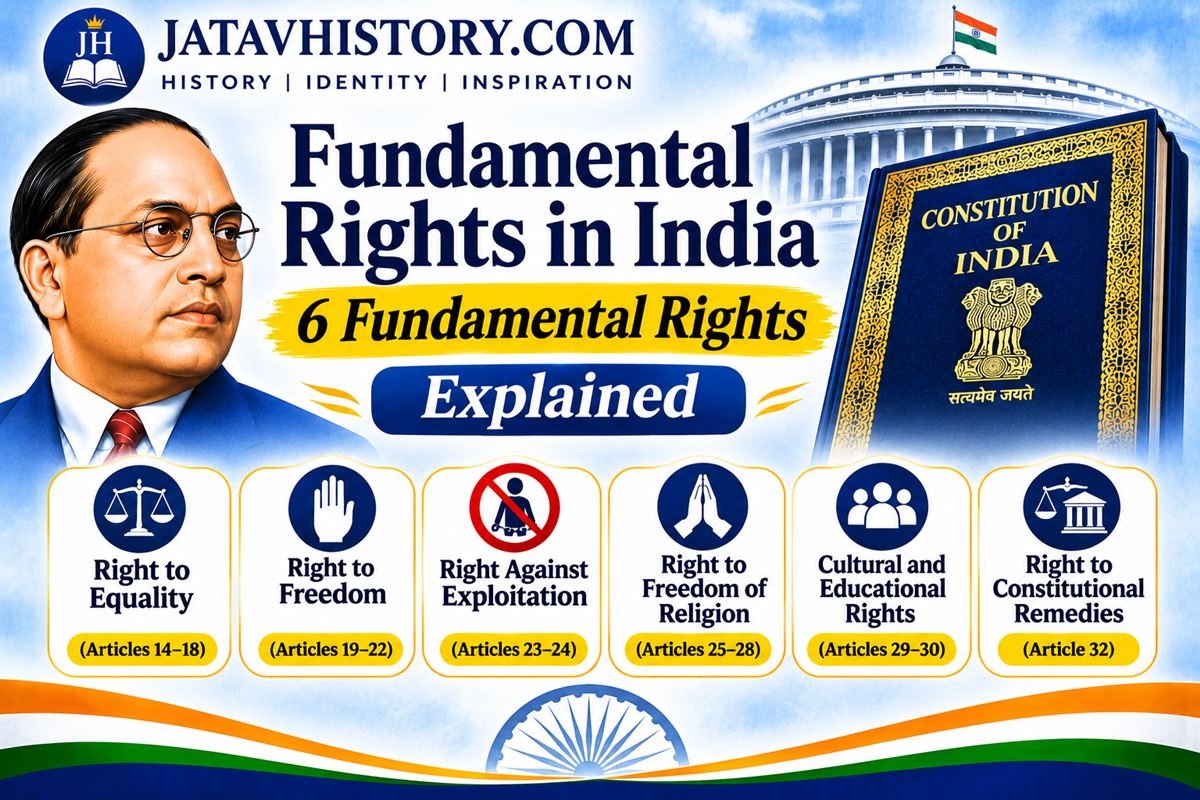
Every person deserves dignity, freedom and fair treatment. In a democratic country, these values should not depend on a person's religion, caste, language, gender or financial condition. The Constitution of India provides important legal protections to support these principles.
These protections are known as Fundamental Rights. They are an essential part of the Indian democratic system and protect individuals against certain forms of discrimination and misuse of power.
The Fundamental Rights of the Indian Constitution are mentioned in Part III, covering Articles 12 to 35. They deal with equality, freedom, protection against exploitation, religious freedom, cultural and educational rights and constitutional remedies.
In this article, we will explain all six Fundamental Rights in simple English. We will also understand their important Articles, examples and why these rights matter in everyday life.
- Part: Part III of the Constitution
- Articles: 12 to 35
- Categories: Six broad categories
- Purpose: Protect freedom, equality and dignity
- Right to Education: Article 21A
- Constitutional remedy: Article 32
- Right to Property: Article 300A, not a Fundamental Right
What Are Fundamental Rights in India?
Fundamental Rights are important rights guaranteed by the Constitution of India. They protect certain freedoms and provide safeguards against actions that violate constitutional provisions.
These rights are called fundamental because they are essential for individual development and democratic life. They help people live with freedom, equality and dignity.
For example, the Constitution protects equality before the law, freedom of speech and expression, religious freedom and the right to approach the Supreme Court for enforcement of Fundamental Rights.
These rights are not unlimited in every situation. The Constitution itself allows certain restrictions and special conditions. For example, some freedoms can be subject to reasonable restrictions under the relevant constitutional provisions.
How Many Fundamental Rights Are There in India?
Fundamental Rights are commonly explained under six broad categories. These categories cover different constitutional protections and freedoms.
- Right to Equality
- Right to Freedom
- Right against Exploitation
- Right to Freedom of Religion
- Cultural and Educational Rights
- Right to Constitutional Remedies
These six categories are part of Part III of the Constitution. Some rights are available to all persons, while certain rights are specifically available to citizens of India.
1. Right to Equality (Articles 14–18)
The Right to Equality is one of the most important Fundamental Rights. It aims to ensure that people receive equal treatment under the law and are not unfairly discriminated against.
It is especially important in a society where discrimination based on caste, religion, gender and other backgrounds has affected people's lives.
Article 14 – Equality Before Law
Article 14 provides equality before the law and equal protection of the laws within India. It means that the State cannot treat people unfairly without a valid legal basis.
The law applies to everyone, including people holding important public positions. No one is above the law.
Article 15 – Prohibition of Discrimination
Article 15 prohibits the State from discriminating against citizens only on grounds of religion, race, caste, sex or place of birth.
It also deals with access to certain public places and allows special provisions for the advancement of women, children, socially and educationally backward classes, Scheduled Castes and Scheduled Tribes, subject to its constitutional clauses.
Article 16 – Equality in Public Employment
Article 16 provides equality of opportunity for citizens in matters relating to employment or appointment to government offices.
It also contains provisions allowing certain forms of reservation and special measures under the conditions stated in the Constitution.
Article 17 – Abolition of Untouchability
Article 17 abolishes untouchability and forbids its practice in any form. Enforcing disabilities arising from untouchability is punishable according to law.
This provision is an important constitutional safeguard against caste-based exclusion.
Read our detailed explanation: Article 17 of the Indian Constitution: Abolition of Untouchability .
Article 18 – Abolition of Titles
Article 18 abolishes titles, except military and academic distinctions. It prevents the State from granting titles that create artificial social distinctions.
National awards such as Bharat Ratna and Padma Awards are not treated as titles when used according to the constitutional principles explained by the Supreme Court.
- Article 14 – Equality before law
- Article 15 – Prohibition of discrimination
- Article 16 – Equality in public employment
- Article 17 – Abolition of untouchability
- Article 18 – Abolition of titles
2. Right to Freedom (Articles 19–22 and 21A)
The Right to Freedom protects important individual freedoms and personal liberty. It allows people to express opinions, move freely, choose occupations and live with dignity, subject to constitutional conditions and restrictions.
Article 19 – Six Important Freedoms
Article 19 provides six freedoms to citizens of India. These freedoms are important for democracy and personal development.
- Freedom of speech and expression.
- Freedom to assemble peacefully and without arms.
- Freedom to form associations, unions or cooperative societies.
- Freedom to move freely throughout India.
- Freedom to reside and settle in any part of India.
- Freedom to practise any profession or carry on any occupation, trade or business.
These freedoms are subject to reasonable restrictions mentioned in the Constitution. For example, freedom of speech does not mean that a person can legally make every kind of statement without consequences.
Article 20 – Protection in Respect of Conviction for Offences
Article 20 provides important protections to people accused or convicted of offences. It includes protection against retrospective criminal punishment, double jeopardy and being compelled to be a witness against oneself.
Article 21 – Protection of Life and Personal Liberty
Article 21 states that no person shall be deprived of life or personal liberty except according to procedure established by law.
The Supreme Court has interpreted this Article broadly through different judgments. It is connected with the protection of human dignity and several aspects of a meaningful life.
Article 21A – Right to Education
Article 21A provides free and compulsory education to all children between the ages of six and fourteen years, in the manner determined by law.
This provision was added through the 86th Constitutional Amendment Act, 2002.
It provides an important constitutional foundation for elementary education in India.
Article 22 – Protection Against Arrest and Detention
Article 22 provides certain safeguards relating to arrest and detention. It includes provisions concerning information about the grounds of arrest, access to legal representation and production before a magistrate, subject to the exceptions and conditions mentioned in the Article.
- Article 19 – Six freedoms
- Article 20 – Protection in criminal cases
- Article 21 – Life and personal liberty
- Article 21A – Right to education
- Article 22 – Protection against arrest and detention
3. Right Against Exploitation (Articles 23–24)
The Right Against Exploitation protects people from certain forms of forced labour, trafficking and harmful child labour.
It is an important protection for vulnerable people who may be forced into work or subjected to exploitation.
Article 23 – Prohibition of Human Trafficking and Forced Labour
Article 23 prohibits trafficking in human beings, begar and other similar forms of forced labour.
It protects people against being forced to work without legal justification. The State can impose compulsory service for public purposes, but it must not discriminate on the grounds specified in this Article.
Article 24 – Prohibition of Child Labour in Certain Workplaces
Article 24 prohibits the employment of children below the age of fourteen years in factories, mines or other hazardous employment.
This provision is intended to protect children from dangerous working conditions and help safeguard their health and development.
Other laws, including child labour legislation, also provide detailed rules and restrictions.
- Article 23 – Prohibition of trafficking and forced labour
- Article 24 – Prohibition of child employment in factories, mines and hazardous work
4. Right to Freedom of Religion (Articles 25–28)
India is a secular country where people follow different religions and beliefs. The Right to Freedom of Religion protects freedom of conscience and religious practices within the limits of the Constitution.
Article 25 – Freedom of Conscience and Religion
Article 25 gives all persons freedom of conscience and the right freely to profess, practise and propagate religion.
This right is subject to public order, morality, health and the other provisions of Part III.
Article 26 – Freedom to Manage Religious Affairs
Article 26 allows every religious denomination or section of it to establish and maintain religious and charitable institutions and manage its religious affairs, subject to constitutional conditions.
Article 27 – Freedom from Certain Religious Taxes
Article 27 protects people from being compelled to pay taxes specifically appropriated for the promotion or maintenance of any particular religion or religious denomination.
Article 28 – Religious Instruction in Educational Institutions
Article 28 deals with religious instruction and religious worship in educational institutions. It sets out restrictions for institutions wholly maintained out of State funds and rules for certain other institutions.
- Article 25 – Freedom of conscience and religion
- Article 26 – Management of religious affairs
- Article 27 – Freedom from certain religious taxes
- Article 28 – Religious instruction in educational institutions
5. Cultural and Educational Rights (Articles 29–30)
India has many languages, cultures, traditions and communities. Cultural and Educational Rights protect important interests relating to language, culture and educational institutions.
Article 29 – Protection of Interests of Minorities
Article 29 protects the right of any section of citizens having a distinct language, script or culture to conserve it.
It also provides protection against denial of admission into State-maintained or State-aided educational institutions on grounds only of religion, race, caste or language.
Article 30 – Right of Minorities to Establish Educational Institutions
Article 30 gives religious and linguistic minorities the right to establish and administer educational institutions of their choice.
It is an important constitutional safeguard for protecting the educational and cultural identity of minority groups.
- Article 29 – Protection of language, script and culture
- Article 30 – Minority educational institutions
6. Right to Constitutional Remedies (Article 32)
Fundamental Rights become meaningful when people have a legal way to protect them. Article 32 provides the right to approach the Supreme Court for enforcement of Fundamental Rights.
Dr. B. R. Ambedkar famously described Article 32 as the heart and soul of the Constitution during the Constituent Assembly discussions.
Article 32 empowers the Supreme Court to issue directions, orders or writs for the enforcement of Fundamental Rights.
Five Types of Writs
The Constitution recognises five important types of writs for constitutional remedies.
- Habeas Corpus: A court order used to examine the legality of a person's detention.
- Mandamus: A direction requiring a public authority to perform a legal duty.
- Prohibition: An order preventing a lower court or tribunal from proceeding beyond its legal authority.
- Certiorari: An order through which a higher court can quash an order of a lower court or tribunal in appropriate cases.
- Quo Warranto: A court order questioning the legal authority of a person holding a public office.
High Courts also have writ powers under Article 226. Their jurisdiction extends to enforcement of Fundamental Rights and for other purposes.
Fundamental Rights and Their Important Articles: Complete Table
The following table gives a quick overview of the six categories and their important constitutional Articles.
| Fundamental Right | Articles | Main Purpose |
|---|---|---|
| Right to Equality | 14–18 | Equality and protection against discrimination |
| Right to Freedom | 19–22, 21A | Freedom, life, liberty and education |
| Right Against Exploitation | 23–24 | Protection against trafficking, forced labour and certain child labour |
| Right to Freedom of Religion | 25–28 | Religious freedom and related protections |
| Cultural and Educational Rights | 29–30 | Protection of cultural interests and minority educational institutions |
| Right to Constitutional Remedies | 32 | Enforcement of Fundamental Rights through the Supreme Court |
Note: Part III also contains other provisions, including Articles 12, 13 and 33 to 35. The table lists the commonly taught six categories and their main Articles.
Are Fundamental Rights Available to Every Person?
Not every Fundamental Right is available in exactly the same way to every person. Some rights are available to all persons, while certain rights are specifically guaranteed to Indian citizens.
For example, Article 14 provides equality before the law to every person. Article 21 protects life and personal liberty of every person.
Article 19, on the other hand, provides its six freedoms to citizens of India.
The wording of each constitutional Article matters. Therefore, it is important to read the relevant provision instead of assuming that every right applies in the same way to everyone.
Can Fundamental Rights Be Restricted?
Yes. Fundamental Rights are important, but many of them are subject to restrictions and conditions mentioned in the Constitution.
For example, Article 19 allows certain reasonable restrictions on the freedoms it guarantees. These restrictions must fall within the grounds provided by the relevant constitutional clauses.
Similarly, religious freedom under Article 25 is subject to public order, morality, health and other provisions of Part III.
This balance helps protect individual freedom while also considering public interest and the rights of other people.
Is Right to Property a Fundamental Right?
No. The Right to Property is no longer a Fundamental Right in India.
Earlier, the Constitution protected property as a Fundamental Right under Articles 19(1)(f) and 31. However, the 44th Constitutional Amendment Act, 1978 removed it from the list of Fundamental Rights.
Today, the Right to Property is protected under Article 300A of the Constitution.
Article 300A says that no person shall be deprived of property save by authority of law. It is a constitutional right, but not a Fundamental Right.
Difference Between Fundamental Rights and Directive Principles
Fundamental Rights and Directive Principles of State Policy are both important parts of the Constitution, but they have different purposes.
| Point | Fundamental Rights | Directive Principles |
|---|---|---|
| Location | Part III | Part IV |
| Articles | 12–35 | 36–51 |
| Purpose | Protect important rights and freedoms | Guide the State in making policies |
| Enforcement | Enforceable through constitutional remedies | Not directly enforceable by courts |
| Main focus | Individual rights and constitutional protections | Social and economic welfare goals |
Why Are Fundamental Rights Important for SC and ST Communities?
Fundamental Rights are important for every citizen, including members of Scheduled Castes and Scheduled Tribes. They provide constitutional protection against discrimination and support equal opportunities.
Article 15 prohibits discrimination on specified grounds, including caste. Article 16 provides equality of opportunity in public employment. Article 17 abolishes untouchability.
The Constitution also allows special provisions for the advancement of Scheduled Castes and Scheduled Tribes under specified constitutional clauses.
These provisions are important because formal equality alone may not remove historical disadvantages. Special measures can help create fairer opportunities for communities that have faced social and educational exclusion.
Read more about these protections: Constitutional Safeguards for SC and ST Communities in India .
How Can a Person Protect Their Fundamental Rights?
If a person's Fundamental Rights are violated, the Constitution provides legal remedies. The correct process depends on the nature of the issue.
- Understand which constitutional right may have been violated.
- Keep relevant documents, notices, messages or other available evidence.
- Seek advice from a qualified lawyer or legal aid authority.
- Approach the appropriate High Court under Article 226 where applicable.
- Approach the Supreme Court under Article 32 for enforcement of Fundamental Rights.
The availability of a particular remedy depends on the facts, the right involved and applicable legal procedures.
Frequently Asked Questions About Fundamental Rights
1. How many Fundamental Rights are there in India?
Fundamental Rights are commonly grouped into six broad categories: Right to Equality, Right to Freedom, Right Against Exploitation, Right to Freedom of Religion, Cultural and Educational Rights, and Right to Constitutional Remedies.
2. Which part of the Constitution contains Fundamental Rights?
Fundamental Rights are included in Part III of the Indian Constitution, covering Articles 12 to 35.
3. What are the six Fundamental Rights?
The six categories are Right to Equality, Right to Freedom, Right Against Exploitation, Right to Freedom of Religion, Cultural and Educational Rights, and Right to Constitutional Remedies.
4. Which Article is known as the Right to Equality?
Articles 14 to 18 deal with the Right to Equality.
5. Which Article abolishes untouchability?
Article 17 of the Indian Constitution abolishes untouchability and forbids its practice in any form.
6. Which Article provides the Right to Education?
Article 21A provides free and compulsory education for children between six and fourteen years of age.
7. Which Article is called the heart and soul of the Constitution?
Article 32 is popularly described as the heart and soul of the Constitution because it provides a way to approach the Supreme Court for enforcement of Fundamental Rights.
8. Is the Right to Property a Fundamental Right?
No. The Right to Property is protected under Article 300A as a constitutional right, but it is no longer a Fundamental Right.
9. Can Fundamental Rights be restricted?
Yes. Several Fundamental Rights are subject to reasonable restrictions and conditions mentioned in the Constitution.
10. Can a person approach the Supreme Court for violation of Fundamental Rights?
Yes. Article 32 guarantees the right to approach the Supreme Court for enforcement of Fundamental Rights.
11. Are Fundamental Rights available to foreigners?
Some Fundamental Rights, such as equality before law under Article 14 and protection of life and personal liberty under Article 21, apply to every person. Other rights, such as those under Article 19, are specifically available to citizens.
12. What is the difference between Fundamental Rights and Directive Principles?
Fundamental Rights are enforceable through courts, while Directive Principles guide the State in making policies and are not directly enforceable by courts.
Conclusion
Fundamental Rights are an essential part of the Indian Constitution. They protect important freedoms, promote equality and help people live with dignity.
From the Right to Equality to the Right to Constitutional Remedies, each category has an important role in India's democratic system. These rights also provide protection against discrimination, exploitation and unfair treatment.
Every citizen should understand these rights and know how they work. Awareness of the Constitution helps people make informed decisions and understand the legal protections available to them.
The Constitution is not only a document for courts and government institutions. Its principles are important for everyday life and for building a society based on equality, justice and dignity.
Official Sources and Further Reading
Explore More About the Indian Constitution
Continue reading our Constitution series to learn about important Articles, rights and safeguards.
- Constitution Day: History and Importance of 26 November
- Dr. B. R. Ambedkar's Role in Making the Indian Constitution
- Preamble of the Indian Constitution
- Article 17: Abolition of Untouchability
- Reservation in the Indian Constitution
- Article 341: Recognition of Scheduled Castes
- Constitutional Safeguards for SC and ST Communities
- How Was the Indian Constitution Written?
- Constitution Day Speech and Essay in English