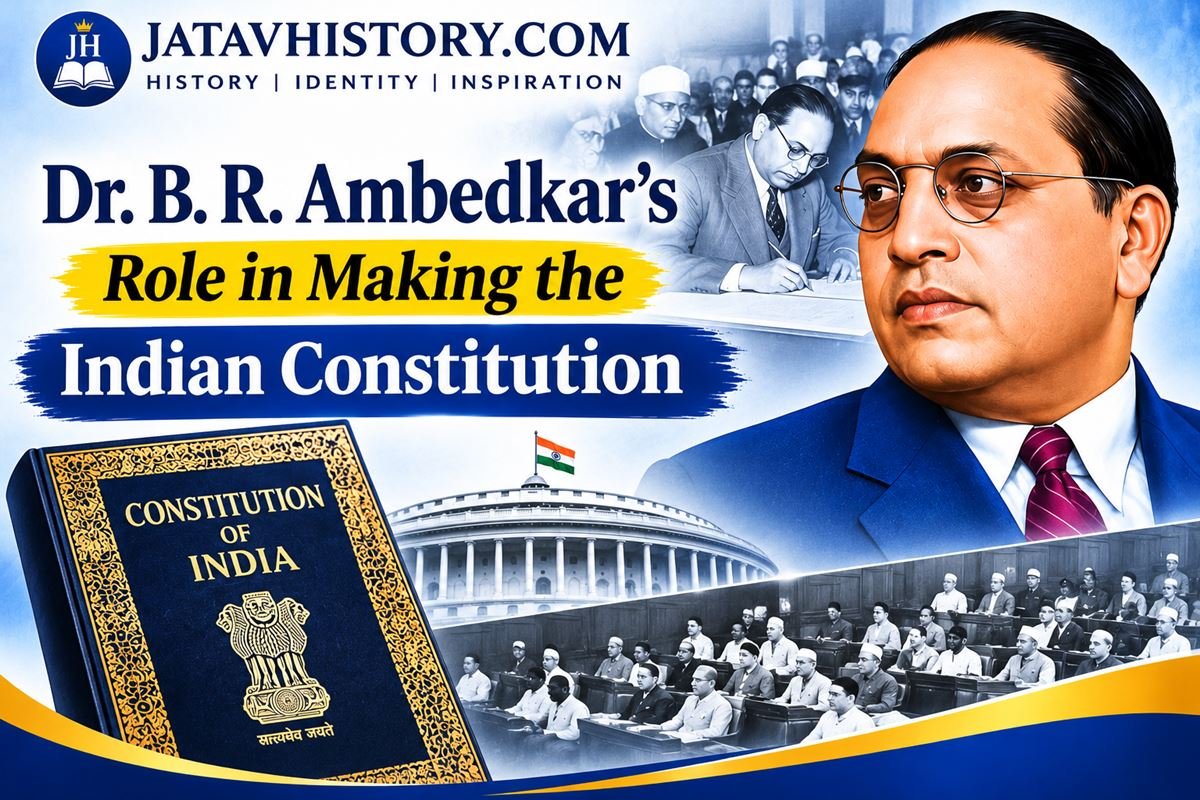
The Constitution of India is the foundation of the country's democratic system. It explains how the government works, defines the powers of different institutions and protects the rights of citizens. Behind this important document were many years of discussion, research and hard work.
Among the people who played an important role in this historic work, Dr. Bhimrao Ramji Ambedkar holds a special place. He was a well-known jurist, economist, social reformer and strong supporter of equality. His knowledge of law and constitutional systems made him an important leader during the making of the Indian Constitution.
Many people know him as the Father of the Indian Constitution or the chief architect of the Indian Constitution. But what exactly did he do? Why was he selected to lead the Drafting Committee? What ideas did he support? And how did his work influence the rights of ordinary citizens?
Let's understand the role of Dr. B. R. Ambedkar in the Indian Constitution in simple words.
- Born: 14 April 1891
- Full name: Bhimrao Ramji Ambedkar
- Drafting Committee appointed: 29 August 1947
- Position: Chairman of the Drafting Committee
- Constitution adopted: 26 November 1949
- First Law Minister: Independent India
- Bharat Ratna: Awarded posthumously in 1990
Who Was Dr. B. R. Ambedkar?
Dr. Bhimrao Ramji Ambedkar was born on 14 April 1891 at Mhow, in present-day Madhya Pradesh. He came from a community that faced untouchability and caste-based discrimination during that period.
From an early age, he experienced social barriers that made education and equal treatment difficult. However, he continued his studies and became one of the most highly educated Indian leaders of his time.
He studied at Columbia University in the United States and the London School of Economics in the United Kingdom. He also studied law and developed a strong understanding of economics, political science and social issues.
Ambedkar believed that education was an important tool for personal development and social change. He worked throughout his life against caste discrimination and for the rights of disadvantaged communities.
His work was not limited to politics. He was also a writer, teacher, economist, lawyer and social reformer. These different experiences helped him understand the challenges of building a fair and democratic country.
How Did Dr. Ambedkar Become Chairman of the Drafting Committee?
After India began its journey towards independence, the Constituent Assembly was given the responsibility of preparing a Constitution for the country.
The Assembly had several committees to examine different subjects. These committees discussed important matters such as the powers of the Union, provincial governments, fundamental rights and the protection of minorities.
On 29 August 1947, the Constituent Assembly appointed the Drafting Committee. Its responsibility was to examine the decisions and reports of the various committees and prepare a draft Constitution for consideration by the Assembly.
Dr. B. R. Ambedkar was appointed Chairman of this committee. His knowledge of constitutional law, experience in public life and understanding of social issues were important strengths for this responsibility.
The Drafting Committee did not work independently of the Constituent Assembly. It worked according to the decisions and discussions of the Assembly and presented its draft for further debate and changes.
- He had deep knowledge of law and constitutional matters.
- He understood the problems of social discrimination.
- He had studied different political and constitutional systems.
- He could explain complex legal provisions clearly.
- He strongly supported equality and protection of individual rights.
What Was the Role of the Drafting Committee?
The Drafting Committee was responsible for preparing the constitutional draft based on the work already completed by the different committees and the decisions of the Constituent Assembly.
Its work involved examining proposals, arranging provisions in a legal structure, checking the language of the draft and making changes where required.
The Draft Constitution was then discussed by the Constituent Assembly. Members raised questions, suggested amendments and debated different provisions before the final text was adopted.
As Chairman, Dr. Ambedkar had the responsibility of guiding the committee's work and presenting the draft before the Assembly. He also answered questions and defended many provisions during the debates.
The committee included several distinguished members. The Constitution was ultimately the result of the combined efforts of the Drafting Committee, other committees, constitutional advisers and the Constituent Assembly.
How Did Ambedkar Contribute to the Indian Constitution?
The contribution of Dr. Ambedkar to the Indian Constitution can be understood through the principles he supported and the work he performed during the drafting process.
1. Support for Equality Before the Law
Ambedkar believed that every person should receive equal treatment under the law. In a society divided by caste and social differences, equality was not just an idea. It was an essential condition for a democratic country.
The Constitution provides equality before the law and equal protection of laws under Article 14. It also contains provisions against discrimination and supports equal opportunity.
These constitutional principles are important for protecting the dignity of people and preventing unfair treatment.
2. Protection of Fundamental Rights
Fundamental Rights are among the most important parts of the Indian Constitution. They protect basic freedoms and provide legal safeguards to individuals.
The rights cover areas such as equality, freedom, protection against exploitation, freedom of religion, cultural and educational rights and constitutional remedies.
Ambedkar strongly supported the idea that citizens should have enforceable rights. He also emphasised the importance of constitutional remedies so that people could approach courts when their rights were violated.
Read our detailed guide: Six Fundamental Rights in the Indian Constitution .
3. Abolition of Untouchability
Untouchability was one of the serious social problems that affected millions of people. It denied people equal access to public places, education and other opportunities.
Article 17 of the Constitution abolishes untouchability and forbids its practice in any form. This was a major constitutional step towards ending a deeply rooted form of social discrimination.
Ambedkar had spent much of his public life fighting against untouchability. The constitutional protection against it reflected the importance of equality and human dignity in the new democratic system.
Read more: Article 17 of the Indian Constitution: Abolition of Untouchability .
4. Special Provisions for Disadvantaged Communities
Ambedkar understood that simply declaring everyone equal would not remove all social disadvantages. Communities that had faced discrimination for generations needed meaningful opportunities to participate in education, employment and public life.
The Constitution provides for special measures for certain disadvantaged groups. These provisions form an important part of India's approach to social justice.
Articles 15 and 16 contain provisions that allow special arrangements in specified circumstances, including for socially and educationally disadvantaged groups and Scheduled Castes and Scheduled Tribes.
Article 46, a Directive Principle of State Policy, asks the State to promote the educational and economic interests of weaker sections, particularly Scheduled Castes and Scheduled Tribes, and protect them from social injustice and exploitation.
Explore this topic: Reservation in the Indian Constitution: Articles 15, 16 and 46 .
5. Constitutional Safeguards for Scheduled Castes
The rights and safeguards of Scheduled Castes were important subjects in Ambedkar's public work. He wanted communities facing historical discrimination to receive legal protection and a fair opportunity to progress.
The Constitution contains several provisions related to the recognition and protection of Scheduled Castes. Article 341 deals with the specification of Scheduled Castes for each State and Union Territory.
Other provisions deal with political representation, public employment, educational interests and protection from discrimination.
Read our related articles:
- Article 341: How Scheduled Castes Are Recognised in India
- Constitutional Safeguards for SC and ST Communities in India
6. Support for Women's Rights
Ambedkar also supported the rights and dignity of women. He believed that a society could not progress properly if women were denied equal opportunities and legal rights.
During his time as India's first Law Minister, he worked towards reforming Hindu personal laws through the Hindu Code Bill. The proposed reforms dealt with matters such as marriage, inheritance and women's legal position.
The Bill faced strong opposition and could not be passed in the form originally proposed during his tenure. Differences over the issue were among the reasons behind his resignation from the Union Cabinet in 1951.
His efforts remain an important part of the history of legal reform and women's rights in India.
Ambedkar's Vision of Social Justice
For Dr. Ambedkar, independence was not only about ending British rule. He wanted people to enjoy freedom in their social and economic lives as well.
He believed that a democratic system could not become successful if society continued to be divided by discrimination and unequal treatment.
His idea of social justice was connected with dignity, equality, education and opportunities for all citizens. He wanted people from disadvantaged communities to participate in the country's progress without facing unfair barriers.
These concerns are reflected in several parts of the Constitution, including Fundamental Rights, Directive Principles of State Policy and provisions relating to social safeguards.
What Did Ambedkar Say About Constitutional Democracy?
Ambedkar understood that a Constitution alone cannot guarantee a successful democracy. Its success also depends on the people and institutions responsible for following it.
During the final stages of the Constituent Assembly debates in November 1949, he discussed the importance of constitutional methods, political democracy and social democracy.
He warned that democratic institutions needed responsible citizens and leaders. He also highlighted the need to build a society based on liberty, equality and fraternity.
His message remains relevant because democracy is not only about elections. It also requires respect for constitutional limits, public institutions and the rights of other people.
Did Dr. Ambedkar Write the Entire Constitution Alone?
This is a common question. Dr. Ambedkar is widely recognised as the chief architect of the Indian Constitution, but it would not be historically correct to say that he wrote the entire Constitution alone.
The Constitution was prepared through the collective work of the Constituent Assembly. Its members discussed different subjects, examined reports, proposed amendments and voted on provisions.
The Drafting Committee, under Ambedkar's chairmanship, prepared and revised the draft. Other members and committees also made important contributions.
Dr. Ambedkar's special contribution was his leadership of the Drafting Committee, his deep knowledge of law and his role in explaining and defending the draft during the Assembly debates.
Recognising the collective process does not reduce his importance. Instead, it helps us understand accurately how the Constitution was made.
What Happened After the Constitution Was Adopted?
The Constituent Assembly adopted the Constitution on 26 November 1949. It came into force on 26 January 1950, and India became a republic.
Dr. Ambedkar served as the first Law Minister of independent India. In this role, he continued to work on legal and social reforms.
He later resigned from the Union Cabinet in 1951. He continued writing, speaking and working on social and political questions.
On 6 December 1956, Dr. Ambedkar passed away in New Delhi. In 1990, he was posthumously awarded the Bharat Ratna, India's highest civilian award.
Why Is Dr. B. R. Ambedkar's Contribution Still Important?
The contribution of Dr. Ambedkar is not limited to the historical process of drafting the Constitution. His ideas continue to be discussed in debates about equality, education, social justice and democracy.
His life also shows the importance of education and determination. Despite facing serious social barriers, he became a respected scholar and national leader through years of study and public work.
For students, his journey is an example of how knowledge can help people question injustice and work towards positive social change.
For citizens, his contribution is a reminder that constitutional rights and democratic values need to be understood, protected and respected.
Frequently Asked Questions About Ambedkar and the Constitution
1. What was Dr. B. R. Ambedkar's role in the Indian Constitution?
Dr. B. R. Ambedkar was the Chairman of the Drafting Committee. He led its work in preparing the draft Constitution and played an important role in explaining its provisions in the Constituent Assembly.
2. Why is Ambedkar called the Father of the Indian Constitution?
He is widely called the Father or chief architect of the Indian Constitution because of his leadership of the Drafting Committee and his major contribution to the constitutional drafting process.
3. When was Dr. Ambedkar appointed Chairman of the Drafting Committee?
The Drafting Committee was appointed on 29 August 1947, and Dr. Ambedkar became its Chairman.
4. Did Dr. Ambedkar write the Indian Constitution alone?
No. The Constitution was prepared through the collective work of the Constituent Assembly, its committees and other contributors. Ambedkar led the Drafting Committee.
5. What was Ambedkar's contribution to Fundamental Rights?
Ambedkar strongly supported enforceable rights, equality and legal remedies. He played an important role in the drafting process through which these constitutional protections were shaped.
6. Which Article of the Constitution abolishes untouchability?
Article 17 of the Indian Constitution abolishes untouchability and forbids its practice in any form.
7. What was Ambedkar's vision of social justice?
He supported a society based on equality, liberty, dignity and opportunities for all. He worked against caste discrimination and social inequality.
8. When did Dr. B. R. Ambedkar receive the Bharat Ratna?
Dr. Ambedkar was awarded the Bharat Ratna posthumously in 1990.
9. What was Ambedkar's role as India's first Law Minister?
He served as the first Law Minister of independent India and worked on legal reforms, including efforts related to the Hindu Code Bill.
10. Why should students study Ambedkar's contribution to the Constitution?
Studying his contribution helps students understand the history of Indian democracy, constitutional rights, social justice and the importance of education.
Conclusion
Dr. B. R. Ambedkar played a leading role in preparing the Constitution of India. His appointment as Chairman of the Drafting Committee placed him at the centre of one of the most important tasks in the history of independent India.
His legal knowledge, understanding of social problems and commitment to equality helped shape the constitutional framework. At the same time, the Constitution was a collective achievement of the Constituent Assembly and many people who contributed to its making.
Remembering Ambedkar means understanding the values he stood for: education, liberty, equality, fraternity and social justice. These values remain important for building a fair and democratic India.
Official Sources and Further Reading
Read More About the Indian Constitution
Explore the other articles in our Indian Constitution series:
- Constitution Day: History and Importance of 26 November
- Preamble of the Indian Constitution
- Article 17: Abolition of Untouchability
- Six Fundamental Rights in India
- Reservation in the Indian Constitution
- Article 341: Scheduled Castes
- Constitutional Safeguards for SC and ST Communities
- How Was the Indian Constitution Written?
- Constitution Day Speech and Essay in English