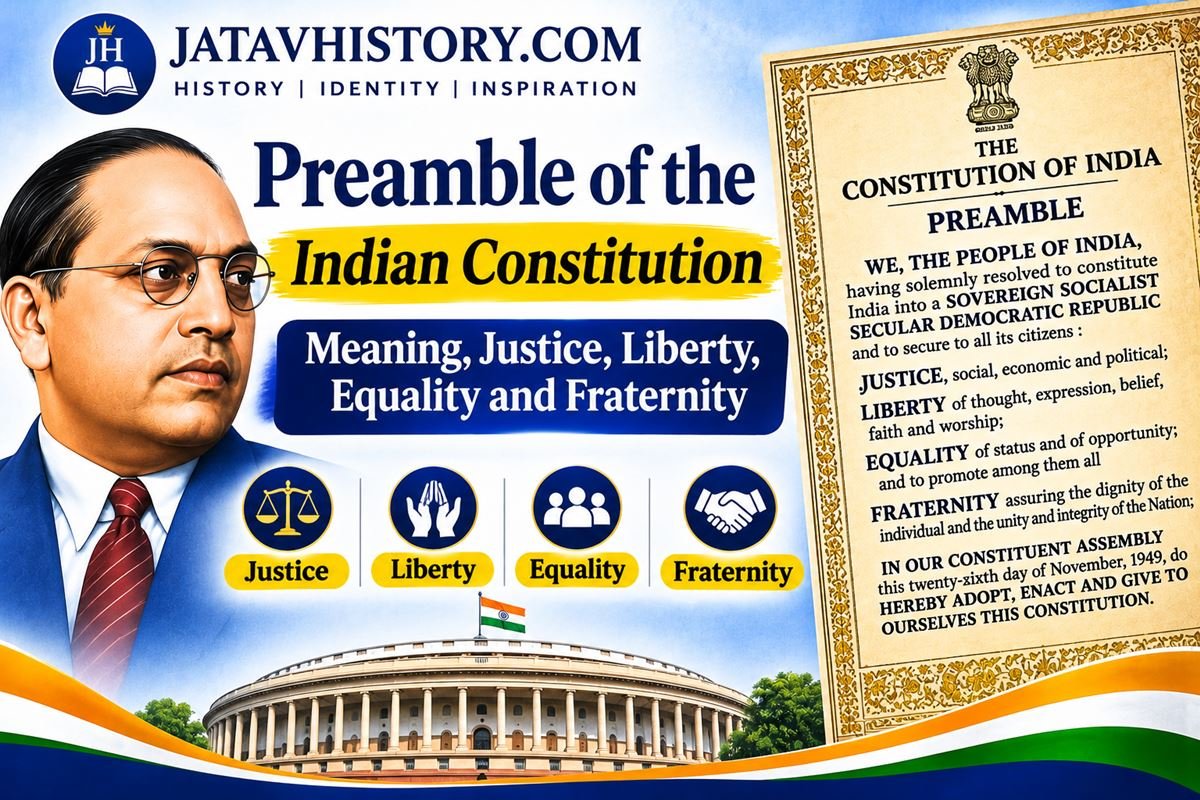
The Constitution of India is the supreme legal document of our country. It explains how the government works, defines the powers of different institutions and protects the rights of citizens. At the beginning of this important document, we find the Preamble.
The Preamble is more than just an introduction. It tells us what kind of country India aims to be and what values should guide its democratic system. It talks about justice, freedom, equality and brotherhood among people.
You may have heard the words "We, the People of India" during school programmes, Constitution Day celebrations or Republic Day events. These words have a deep meaning. They remind us that the authority of the Constitution comes from the people of India.
In this article, we will explain the Preamble of the Indian Constitution, its history, the meaning of every important word and why it still matters in our daily lives.
- Adopted: 26 November 1949
- Part of: Constitution of India
- Opening words: We, the People of India
- Main objectives: Justice, Liberty, Equality and Fraternity
- Important amendment: 42nd Constitutional Amendment Act, 1976
- Famous description: The introduction to the Constitution
What Is the Preamble of the Indian Constitution?
The Preamble is the introductory statement of the Constitution of India. It explains the basic philosophy, objectives and values behind the Constitution.
In simple words, the Preamble tells us what India stands for and what the Constitution promises to its citizens. It declares India to be a Sovereign, Socialist, Secular, Democratic Republic and identifies Justice, Liberty, Equality and Fraternity as important constitutional goals.
The Preamble also explains that the Constitution is adopted and given to ourselves by the people of India. This is why its opening words are so meaningful: "We, the People of India."
It is important to understand that the Preamble does not work like an independent list of enforceable rights. It helps explain the philosophy of the Constitution and guides the interpretation of its provisions.
Full Text of the Preamble of the Indian Constitution
The following is the current text of the Preamble of the Constitution of India:
PREAMBLE
WE, THE PEOPLE OF INDIA, having solemnly resolved to constitute India into a SOVEREIGN SOCIALIST SECULAR DEMOCRATIC REPUBLIC and to secure to all its citizens:
JUSTICE, social, economic and political;
LIBERTY of thought, expression, belief, faith and worship;
EQUALITY of status and of opportunity;
and to promote among them all
FRATERNITY assuring the dignity of the individual and the unity and integrity of the Nation;
IN OUR CONSTITUENT ASSEMBLY this twenty-sixth day of November, 1949, do HEREBY ADOPT, ENACT AND GIVE TO OURSELVES THIS CONSTITUTION.
This is the current Preamble after the changes made through the 42nd Constitutional Amendment Act, 1976. The words "Socialist" and "Secular" and the expression "unity and integrity" were added through this amendment.
Meaning of "We, the People of India"
The Preamble begins with the words "We, the People of India". These words explain the source of constitutional authority.
It means that the Constitution is not a gift from a king, ruler or foreign government. It was adopted by the representatives of the people in the Constituent Assembly.
These words also express the idea of popular sovereignty. In a democracy, the people are the ultimate source of political authority, and elected representatives exercise power under the Constitution.
The phrase gives a strong message that every citizen is part of the same constitutional system, regardless of caste, religion, language, gender or place of birth.
Meaning of the Five Key Words in the Preamble
The Preamble uses five important words to describe the nature of the Indian State. These words are Sovereign, Socialist, Secular, Democratic and Republic. Each one explains a different feature of India.
1. Sovereign
Sovereign means that India is an independent country and has the authority to make its own decisions. No foreign country has the legal power to control India's internal government or dictate its national policies.
India can make its own laws, decide its economic policies, maintain diplomatic relations and take decisions according to its national interests.
In simple words, sovereignty means that India is free from external political control.
2. Socialist
The word Socialist reflects the commitment to social and economic justice. It highlights the need to reduce inequalities and improve the living conditions of people.
In the Indian context, socialism does not mean that every person must have exactly the same income or property. It expresses the idea of a welfare-oriented State that works to provide fair opportunities, reduce poverty and support disadvantaged sections.
Government programmes related to education, healthcare, social security and welfare are examples of efforts connected with these broader goals.
3. Secular
Secular means that India does not have an official State religion. People are free to follow, practise and profess their religion, subject to the constitutional limitations.
The State must respect religious freedom and cannot treat citizens unfairly simply because of their religious beliefs.
India is home to people belonging to many religions and faiths. The principle of secularism supports peaceful coexistence and equal respect for citizens.
4. Democratic
Democratic means that the government gets its authority from the people. Citizens choose their representatives through elections.
In a democracy, people have political rights, including the right to participate in elections according to law. The government is accountable to the people and must work within constitutional limits.
Democracy is not only about voting. It also includes freedom of expression, public participation, equality and respect for different opinions.
5. Republic
Republic means that the head of the Indian State is elected and does not hold the position because of birth or family inheritance.
India has an elected President. The office of President is not a hereditary position like a monarchy.
This principle reflects the democratic character of the Indian political system.
Justice, Liberty, Equality and Fraternity: The Four Main Objectives
After explaining the nature of India, the Preamble describes four important objectives that the Constitution seeks to secure for citizens. These are Justice, Liberty, Equality and Fraternity.
1. Justice – Social, Economic and Political
Justice means that every person should receive fair treatment and should not face unfair discrimination. The Preamble describes three forms of justice: social, economic and political.
Social Justice: Social justice means reducing discrimination and unfair social practices. It supports equal dignity and respect for all people. It is especially important in a society where caste, gender and other forms of inequality have affected people's opportunities.
Economic Justice: Economic justice focuses on reducing unfair economic inequalities and creating better opportunities for people to improve their lives.
Political Justice: Political justice means that citizens should have fair opportunities to participate in the political system, including through elections and public representation.
2. Liberty – Freedom of Thought and Expression
Liberty means freedom. The Preamble refers to liberty of thought, expression, belief, faith and worship.
It allows individuals to think independently, express their views and follow their beliefs. These freedoms are essential for a healthy democracy.
However, constitutional freedoms are not unlimited. Certain reasonable restrictions may apply under the relevant constitutional provisions and laws.
3. Equality – Equal Status and Opportunity
Equality means that all people should enjoy equal status and fair opportunities. No person should be treated as inferior because of their background.
The Constitution supports equality before the law and prohibits discrimination on specified grounds. It also allows certain special provisions to address disadvantages faced by particular groups.
Equality does not always mean treating every person in exactly the same way. Sometimes, special measures are required to create fair opportunities.
4. Fraternity – Brotherhood and Dignity
Fraternity means a feeling of brotherhood and mutual respect among people. It encourages citizens to treat one another as equal members of the same nation.
The Preamble connects fraternity with the dignity of the individual and the unity and integrity of the nation.
This value is especially important for a diverse country like India, where people speak different languages, follow different religions and belong to different communities.
- Justice – Fairness in social, economic and political life.
- Liberty – Freedom of thought, expression, belief, faith and worship.
- Equality – Equal status and opportunity.
- Fraternity – Brotherhood, individual dignity and national unity.
History of the Preamble of the Indian Constitution
The Preamble developed during the discussions of the Constituent Assembly. Its ideas were influenced by the objectives and principles that the Assembly wanted the Constitution to express.
The Objectives Resolution moved by Jawaharlal Nehru on 13 December 1946 was an important foundation for the philosophy of the Preamble. The Resolution was adopted by the Constituent Assembly on 22 January 1947.
The Preamble was debated as part of the final constitutional process. The Constituent Assembly adopted the Constitution on 26 November 1949.
The Constitution came into force on 26 January 1950. This date is celebrated every year as Republic Day.
If you want to understand the complete story of Constitution-making, read our article: How Was the Indian Constitution Written? .
42nd Constitutional Amendment: What Changed in the Preamble?
The Preamble was amended through the Constitution (Forty-second Amendment) Act, 1976. This amendment made three important changes to its wording.
- The word "Socialist" was added.
- The word "Secular" was added.
- The expression "unity of the Nation" was changed to "unity and integrity of the Nation".
These changes came into effect on 3 January 1977. The amendment is often called the Mini Constitution because it made several changes to different parts of the Constitution.
It is important to remember that the original Preamble already contained the values of justice, liberty, equality and fraternity. The words Socialist and Secular were formally inserted later through the 42nd Amendment.
Is the Preamble Part of the Indian Constitution?
Yes. The Supreme Court of India clarified in the Kesavananda Bharati case in 1973 that the Preamble is part of the Constitution.
The Court also explained that the Preamble is important for understanding the basic philosophy and objectives of the Constitution.
However, the Preamble does not independently create enforceable rights. It cannot be used as a separate source of power to override the specific provisions of the Constitution.
It serves as a guide when courts interpret constitutional provisions and understand the intentions behind the document.
Why Is the Preamble Called the Soul of the Constitution?
The Preamble is often described as the soul or guiding spirit of the Constitution because it expresses the main ideals behind the entire constitutional system.
It gives readers a quick understanding of what the Constitution aims to achieve. It also provides a common direction for interpreting the values of democracy, justice and equality.
When we discuss discrimination, religious freedom, equal opportunity or individual dignity, the values mentioned in the Preamble become especially meaningful.
The Preamble does not replace the detailed articles of the Constitution. Instead, it helps us understand the larger purpose behind those provisions.
Importance of the Preamble in Everyday Life
The Preamble may look like a short paragraph at the beginning of a legal document, but its values have a connection with everyday life.
- At school: Every student deserves dignity, respect and fair opportunities.
- At the workplace: People should not face unfair discrimination.
- In society: Citizens should respect people from different communities.
- In public life: Everyone should have the opportunity to participate in democratic processes.
- In personal freedom: People should be able to express their views and follow their beliefs within the law.
These values remind us that the Constitution is not only about government institutions. It also has an important place in the lives of ordinary citizens.
Difference Between the Preamble and Fundamental Rights
The Preamble and Fundamental Rights are both important parts of the Constitution, but they perform different functions.
| Point | Preamble | Fundamental Rights |
|---|---|---|
| Meaning | Introduction and statement of constitutional objectives. | Specific rights guaranteed under Part III. |
| Main purpose | Explains the philosophy of the Constitution. | Protects specified rights and freedoms. |
| Location | At the beginning of the Constitution. | Part III, Articles 12 to 35. |
| Enforcement | Not independently enforceable as a source of rights. | Can be enforced through constitutional remedies. |
| Examples | Justice, Liberty, Equality and Fraternity. | Equality, Freedom and Freedom of Religion. |
You can read the complete explanation here: Fundamental Rights in the Indian Constitution .
How Can Students Learn the Preamble Easily?
Students preparing for school exams, competitive examinations or Constitution Day programmes should understand the Preamble instead of simply memorising its words.
Here are some simple ways to learn it:
- Read the complete Preamble aloud every day.
- Understand the meaning of the five words describing India.
- Remember the four objectives: Justice, Liberty, Equality and Fraternity.
- Learn the date of adoption: 26 November 1949.
- Remember the 42nd Amendment of 1976.
- Try explaining each value with an example from daily life.
Students can also read the official text of the Constitution and use educational material published by NCERT.
Frequently Asked Questions About the Preamble
1. What is the Preamble of the Indian Constitution?
The Preamble is the introductory statement of the Indian Constitution. It explains the basic values and objectives of India, including justice, liberty, equality and fraternity.
2. Who wrote the Preamble of the Indian Constitution?
The Preamble was developed through the collective work of the Constituent Assembly. Its philosophy was strongly influenced by Jawaharlal Nehru's Objectives Resolution.
3. When was the Preamble adopted?
The Preamble was adopted along with the Constitution of India on 26 November 1949.
4. What are the four main objectives of the Preamble?
The four main objectives are Justice, Liberty, Equality and Fraternity.
5. How many key words describe India in the Preamble?
Five important words describe India: Sovereign, Socialist, Secular, Democratic and Republic.
6. When were Socialist and Secular added to the Preamble?
The words Socialist and Secular were added through the 42nd Constitutional Amendment Act, 1976. The changes came into effect on 3 January 1977.
7. Is the Preamble part of the Constitution?
Yes. The Supreme Court held in the Kesavananda Bharati case in 1973 that the Preamble is part of the Constitution.
8. Can the Preamble be changed?
The Preamble can be amended under Article 368, subject to the basic structure doctrine. It was amended through the 42nd Amendment in 1976.
9. What does We the People of India mean?
It means that the authority of the Constitution comes from the people of India and that the Constitution was adopted by their representatives.
10. Why is the Preamble important?
It explains the philosophy and objectives of the Constitution and guides the interpretation of its provisions.
11. What is the meaning of Justice, Liberty, Equality and Fraternity?
Justice means fairness, Liberty means freedom, Equality means equal status and opportunity, and Fraternity means brotherhood, dignity and national unity.
12. Where can I download the Preamble of the Indian Constitution PDF?
You can visit the official Legislative Department website to access the Constitution of India and its Preamble.
Conclusion
The Preamble of the Indian Constitution gives us a clear picture of the values on which our country is built. It speaks about independence, democracy, social justice, freedom, equality and brotherhood.
The words "We, the People of India" remind us that the Constitution belongs to the people. It is not only a legal document for government officials, lawyers or judges. It is important for every citizen.
Understanding the Preamble helps us understand why equality, dignity and freedom matter in a democratic society. These are not just words to remember for an examination. They are values that should guide our everyday behaviour.
A better understanding of the Preamble is also a good starting point for learning about the Fundamental Rights, constitutional safeguards and the responsibilities of citizens.
Official Sources and Further Reading
Explore More About the Indian Constitution
Continue reading our Constitution series to understand important constitutional events, rights and safeguards.
- Constitution Day: History and Importance of 26 November
- Dr. B. R. Ambedkar's Role in Making the Indian Constitution
- Article 17: Abolition of Untouchability
- Six Fundamental Rights in India
- Reservation in the Indian Constitution
- Article 341: Recognition of Scheduled Castes
- Constitutional Safeguards for SC and ST Communities
- How Was the Indian Constitution Written?
- Constitution Day Speech and Essay in English