The Constitution of India provides several safeguards for communities that have faced historical social discrimination and exclusion. Scheduled Castes, commonly known as SCs, are among the communities covered by these constitutional protections.
But how does a community receive official Scheduled Caste status? Who prepares the SC list? Can a State Government add a new caste to the list? Can a caste recognised as SC in one State automatically receive the same status in another State?
These questions are connected with Article 341 of the Indian Constitution. This Article provides the legal process through which communities are specified as Scheduled Castes for a particular State or Union Territory.
Understanding Article 341 is important for students, researchers, people applying for SC caste certificates and anyone interested in constitutional safeguards and social justice.
In this article, we will explain Article 341 in simple English, including the Constitution (Scheduled Castes) Order, 1950, state-wise SC lists, the role of Parliament and important Supreme Court judgments.
- Subject: Scheduled Castes
- Part: Part XVI of the Constitution
- Clause 341(1): Presidential notification specifying Scheduled Castes.
- Clause 341(2): Parliament's power to include or exclude entries by law.
- First major Order: Constitution (Scheduled Castes) Order, 1950.
- Related Article: Article 342 deals with Scheduled Tribes.
What Is Article 341 of the Indian Constitution?
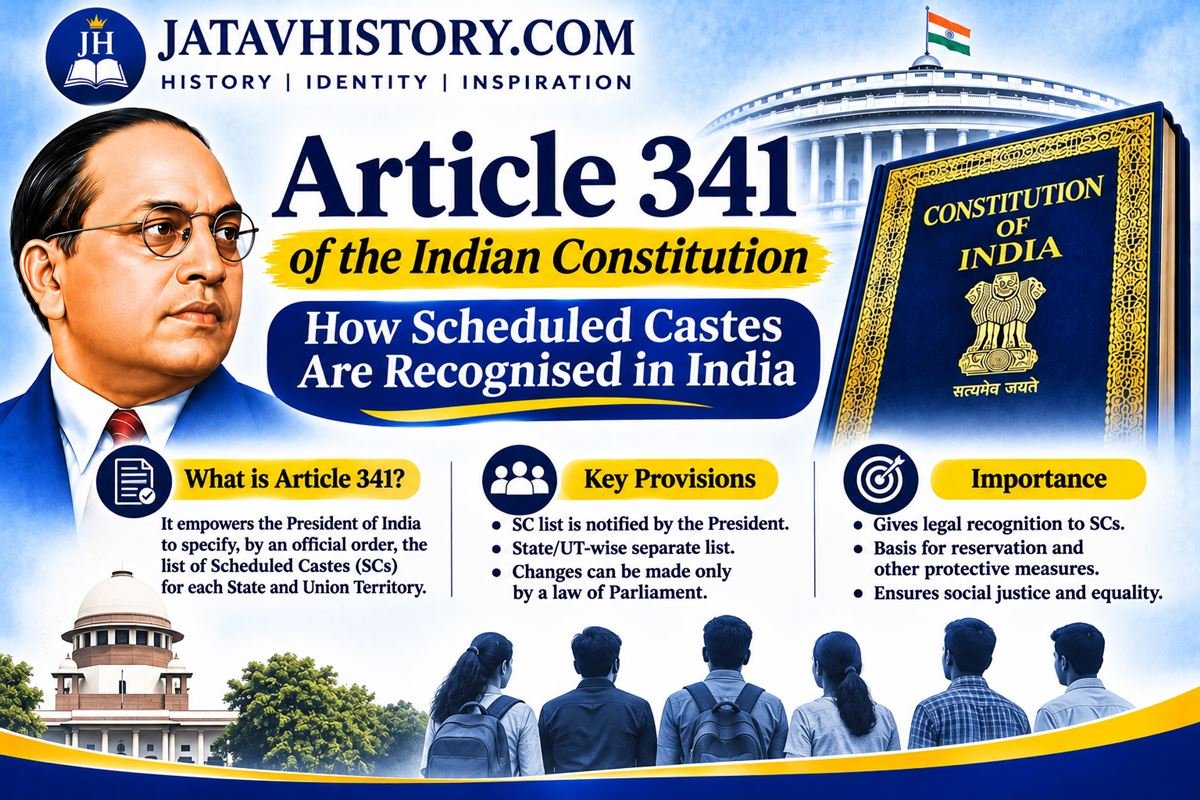
Article 341 deals with the identification and official recognition of Scheduled Castes in India.
It gives the President the power to specify which castes, races, tribes or groups within them will be treated as Scheduled Castes for constitutional purposes in a particular State or Union Territory.
The Article has two clauses:
- Article 341(1): Provides for the Presidential notification specifying Scheduled Castes in relation to a State or Union Territory.
- Article 341(2): Gives Parliament the power to include or exclude any caste, race, tribe or group from the notified list through a law.
In simple words, Article 341 establishes the constitutional process for deciding which communities are officially recognised as Scheduled Castes in different parts of India.
What Does Article 341(1) Say?
Article 341(1) provides that the President may, by public notification, specify the castes, races or tribes, or parts or groups within them, which will be considered Scheduled Castes in relation to a particular State or Union Territory.
In the case of a State, the provision refers to consultation with the Governor before the notification is issued.
This means the SC list is not simply a general list that applies identically everywhere. The official list is connected with the particular State or Union Territory.
The communities included in the Presidential Order are recognised for the purposes of the Constitution in relation to that State or Union Territory.
What Does Article 341(2) Say?
Article 341(2) explains who has the legal authority to change the list of Scheduled Castes.
Under this clause, Parliament may pass a law to include a caste, race, tribe or group in the existing Scheduled Castes list or remove an entry from that list.
The clause also makes it clear that the original Presidential notification cannot be changed through another ordinary notification. Changes must follow the constitutional process provided under Article 341(2).
What Is the Constitution (Scheduled Castes) Order, 1950?
The Constitution (Scheduled Castes) Order, 1950 is one of the most important legal documents connected with Article 341.
It specifies the communities that are recognised as Scheduled Castes in relation to different States and Union Territories.
The Order was issued after the Constitution came into force. It has been amended through different Acts of Parliament over the years.
When someone wants to check whether a particular caste is included in the official SC list, the relevant Presidential Order and its amendments are important legal references.
The Ministry of Social Justice and Empowerment publishes the Constitution (Scheduled Castes) Orders and related documents on its official website.
Official reference: Scheduled Castes Orders – Ministry of Social Justice and Empowerment .
Why Is the Scheduled Castes List Different for Different States?
One important feature of Article 341 is that Scheduled Caste recognition is provided in relation to a particular State or Union Territory.
This means that a community may be included in the Scheduled Castes list for one State but may not have the same recognition in another State.
The Presidential Orders specify communities in relation to the relevant State or Union Territory. Therefore, checking the correct state-wise list is very important.
For example, a person should not assume that because their caste appears in the SC list of Uttar Pradesh, it will automatically appear in the SC list of Uttarakhand.
The applicable list must be checked for the State or Union Territory relevant to the person's claim.
Can a Person Get SC Benefits After Moving to Another State?
This is one of the most common questions about Article 341. People often move from one State to another for education, employment, business or family reasons.
However, moving to another State does not automatically change the State-specific Scheduled Caste recognition.
The Supreme Court has explained that a person belonging to a Scheduled Caste in one State does not automatically become entitled to claim the same Scheduled Caste benefits in another State merely because the same caste name appears in that State's list.
The person's origin, the relevant Presidential Order and applicable government rules must be considered.
This is why people applying for admission, government jobs or other benefits should carefully read the relevant notification and certificate instructions.
For a specific migration or certificate issue, the competent authority or a qualified legal professional should be consulted.
How Is a Caste Added to the Scheduled Castes List?
Many people ask how a community can be included in the SC caste list. Article 341 provides a specific constitutional procedure for this.
A request for inclusion or modification may begin with a proposal from the concerned State Government or Union Territory Administration.
The proposal is examined under the Government's approved procedures. The Registrar General of India and the National Commission for Scheduled Castes have important roles in the examination process.
The Government's published modalities provide for examination of proposals and the required recommendations before an amendment is considered.
General Process for Inclusion in the SC List
- A proposal for inclusion or modification is raised by the concerned State Government or Union Territory Administration.
- The proposal is examined under the prescribed government procedure.
- The Registrar General of India examines the proposal.
- The National Commission for Scheduled Castes is involved in the examination process.
- If the proposal proceeds through the required process, the Central Government may bring forward an amendment Bill in Parliament.
- Parliament considers the Bill and may pass a law to include or exclude an entry from the list.
This is a general explanation of the process. A community does not become a Scheduled Caste merely because a proposal has been submitted or a demand has been made.
Can a State Government Add a Caste to the SC List?
No. A State Government cannot independently change the Presidential Scheduled Castes list.
The State Government can examine and forward proposals under the prescribed process. However, the constitutional power to include or exclude entries from the list through legislation belongs to Parliament under Article 341(2).
A State Government certificate, notification or recommendation cannot by itself amend the Presidential list.
How Can You Check the Official SC Caste List?
Before applying for an SC caste certificate, it is important to check the official Scheduled Castes list for the relevant State or Union Territory.
Follow these general steps:
- Visit the Ministry of Social Justice and Empowerment website.
- Open the section containing Scheduled Castes Orders.
- Select the relevant Presidential Order for your State or Union Territory.
- Find the relevant State section in the document.
- Check the exact caste name and any conditions or area-specific wording.
- Read later amendments that may have changed the original list.
Do not rely only on an old PDF, social media post or an unofficial caste list. Always check the latest official order and amendments.
Click here to check official Scheduled Castes Orders.
What Is the Difference Between Article 341 and Article 342?
Article 341 and Article 342 are related provisions, but they deal with different constitutional categories.
| Point | Article 341 | Article 342 |
|---|---|---|
| Subject | Scheduled Castes | Scheduled Tribes |
| Clause (1) | President specifies SC communities | President specifies ST communities |
| Clause (2) | Parliament can include or exclude SC entries by law | Parliament can include or exclude ST entries by law |
| Main Order | Constitution (Scheduled Castes) Order, 1950 | Constitution (Scheduled Tribes) Order, 1950 |
What Is the Difference Between SC List and OBC List?
Scheduled Castes and Other Backward Classes are different constitutional and administrative categories.
The Scheduled Castes list is specified under Article 341. The Central List of Socially and Educationally Backward Classes is connected with Article 342A.
The process, legal provisions and applicable certificates are different for these categories. A community's inclusion in an OBC list does not automatically mean it is included in the Scheduled Castes list.
Similarly, an SC certificate and an OBC certificate are not interchangeable.
Can the Same Caste Name Have Different Recognition in Different States?
Yes. The Scheduled Castes list is State-specific under Article 341. Therefore, the same or similar community name may have different recognition depending on the relevant State or Union Territory and the exact wording of its Presidential Order.
In some cases, the Order may also specify a particular area, group or part of a community.
This is why checking the exact entry is important. A similar name alone is not enough to establish Scheduled Caste status.
Can Courts Add a Caste to the SC List?
Courts can examine legal disputes involving Scheduled Caste status and the interpretation of Article 341. However, a court cannot independently add a new caste to the Presidential list by treating it as an amendment to that list.
Article 341(2) gives Parliament the power to include or exclude entries through legislation.
The Supreme Court has repeatedly explained the importance of following this constitutional process.
Supreme Court Judgments Related to Article 341
Several Supreme Court judgments have explained how Article 341 should be understood and applied. Some important decisions are discussed below.
1. Marri Chandra Shekhar Rao v. Dean, Seth G.S. Medical College
This case dealt with the issue of Scheduled Caste recognition when a person moves from one State to another.
The judgment is important for understanding why Scheduled Caste recognition in one State does not automatically provide the same benefits in another State.
2. Action Committee on Issue of Caste Certificate to SCs/STs in Maharashtra v. Union of India
This judgment discussed the State-specific nature of Scheduled Caste and Scheduled Tribe recognition. It is an important reference for understanding the Presidential Orders and migration-related claims.
3. State of Punjab v. Davinder Singh (2024)
In August 2024, a seven-judge Constitution Bench of the Supreme Court delivered an important judgment concerning sub-classification within Scheduled Castes.
The Court held that States can make sub-classification within the Scheduled Castes for the purpose of distributing reservation benefits, subject to constitutional requirements and adequate justification.
The judgment also made clear that a State cannot alter or expand the Presidential Scheduled Castes list under Article 341.
Sub-classification for distributing reservation benefits and changing the official SC list are two different legal issues.
Does Article 341 Protect SC Communities?
Article 341 provides the constitutional basis for identifying Scheduled Castes. Other constitutional provisions and laws provide different safeguards and benefits to recognised Scheduled Castes.
Some important provisions connected with SC communities include:
- Article 15(4): Special provisions for the advancement of socially and educationally backward classes, SCs and STs.
- Article 16(4): Reservation in public employment for inadequately represented backward classes.
- Article 17: Abolition of untouchability.
- Article 46: Promotion of educational and economic interests of weaker sections, especially SCs and STs.
- Article 330: Reservation of seats for SCs and STs in the Lok Sabha.
- Article 332: Reservation of seats for SCs and STs in State Legislative Assemblies.
Read more about these constitutional protections: Constitutional Safeguards for SC and ST Communities in India .
Frequently Asked Questions About Article 341
1. What is Article 341 of the Indian Constitution?
Article 341 provides the constitutional procedure for specifying Scheduled Castes in relation to different States and Union Territories.
2. What does Article 341(1) say?
Article 341(1) empowers the President to specify castes, races or tribes as Scheduled Castes for a particular State or Union Territory through a public notification.
3. What does Article 341(2) say?
Article 341(2) gives Parliament the power to include or exclude entries in the Scheduled Castes list through a law.
4. Who can add a caste to the SC list?
Parliament can include a caste in the Scheduled Castes list through legislation under Article 341(2).
5. Can a State Government add a caste to the SC list?
No. A State Government may forward a proposal under the prescribed procedure, but it cannot independently change the Presidential Scheduled Castes list.
6. What is the Constitution (Scheduled Castes) Order, 1950?
It is the Presidential Order that specifies Scheduled Castes in relation to different States and Union Territories. It has been amended through laws passed by Parliament.
7. Is the SC caste list the same in every State?
No. Scheduled Caste recognition is State or Union Territory-specific under Article 341.
8. Can a person claim SC benefits in another State after migration?
Not automatically. SC recognition in one State does not by itself establish entitlement to the same State-specific benefits in another State. The relevant Presidential Order and applicable rules must be checked.
9. What is the difference between Article 341 and Article 342?
Article 341 deals with Scheduled Castes, while Article 342 deals with Scheduled Tribes.
10. Can a court add a new caste to the SC list?
No. Courts can decide legal disputes and interpret the Constitution, but inclusion or exclusion from the Presidential list must follow Article 341(2) through a law made by Parliament.
11. What is the 2024 Supreme Court judgment on SC sub-classification?
In State of Punjab v. Davinder Singh (2024), the Supreme Court held that States can make sub-classification within Scheduled Castes for distributing reservation benefits, subject to constitutional requirements. States cannot change the Presidential SC list.
12. Where can I check the official Scheduled Castes list?
You can check the Scheduled Castes Orders published by the Ministry of Social Justice and Empowerment on its official website.
Conclusion
Article 341 is an important provision of the Indian Constitution because it establishes the legal process for identifying Scheduled Castes in different States and Union Territories.
Article 341(1) provides for the Presidential notification, while Article 341(2) gives Parliament the authority to include or exclude entries through legislation.
The State-specific nature of the SC list is also important. A caste recognised as Scheduled Caste in one State does not automatically receive the same recognition in another State.
Understanding Article 341 helps people check official caste lists, understand caste certificate rules and learn how constitutional safeguards work in India.
Awareness of the Constitution is important for every citizen. Knowing these provisions helps people understand the legal foundation of equality, representation and social justice.
Official Sources and Further Reading
Explore More About the Indian Constitution
Read our other articles to understand the Constitution, important Articles and safeguards for disadvantaged communities.
- Constitution Day: History and Importance of 26 November
- Dr. B. R. Ambedkar's Role in Making the Indian Constitution
- Preamble of the Indian Constitution
- Article 17: Abolition of Untouchability
- Six Fundamental Rights in India
- Reservation in the Indian Constitution
- Constitutional Safeguards for SC and ST Communities
- How Was the Indian Constitution Written?
- Constitution Day Speech and Essay in English