The Constitution of India is based on the values of justice, liberty, equality and fraternity. These values are important for every citizen, but they have special importance for communities that have faced historical discrimination, social exclusion and unequal opportunities.
Scheduled Castes (SCs) and Scheduled Tribes (STs) have faced different social, educational and economic challenges over many generations. The Constitution recognises the need to protect their rights and improve their participation in education, employment and public life.
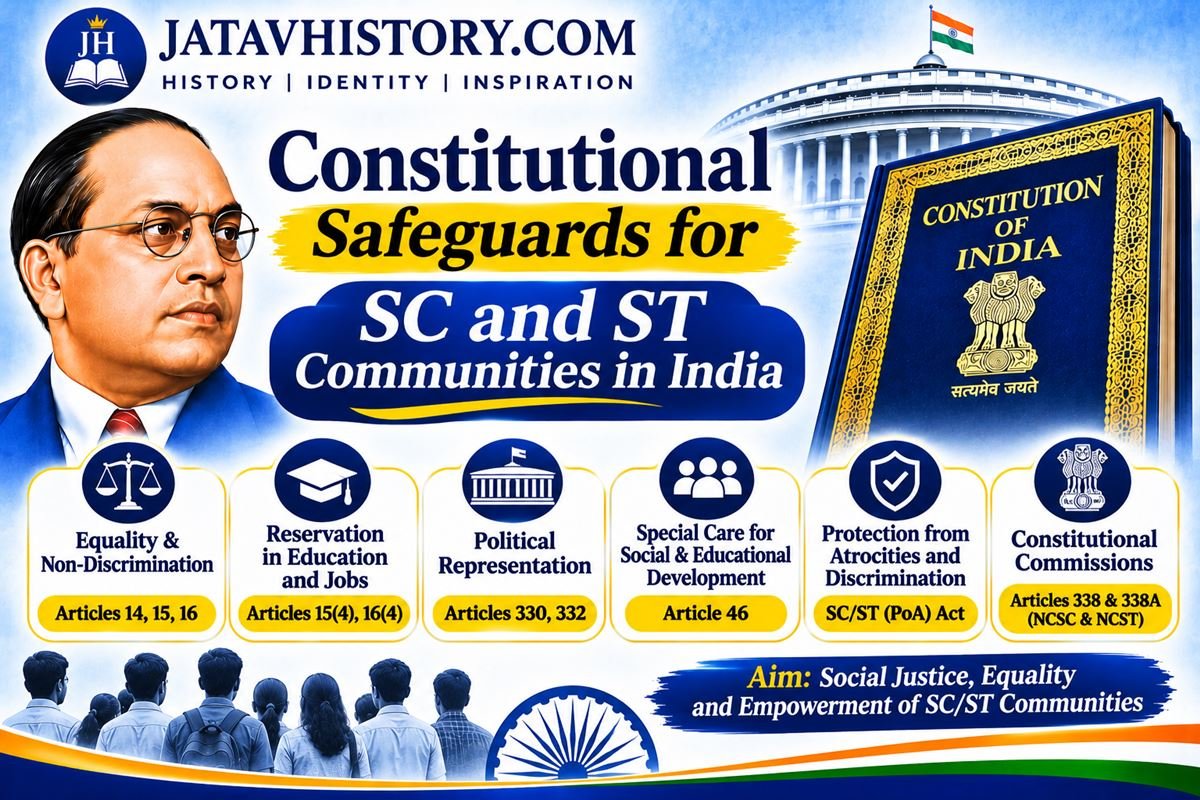
For this purpose, the Constitution contains several safeguards. These include Fundamental Rights, Directive Principles of State Policy, reservation provisions, political representation and constitutional bodies that monitor the implementation of safeguards.
Many people know about SC ST reservation, but fewer people understand the wider constitutional framework behind it. For example, Article 17 abolishes untouchability, Article 46 promotes the educational and economic interests of weaker sections, and Articles 338 and 338A establish separate National Commissions for SCs and STs.
In this article, we will explain the important constitutional safeguards for SC and ST communities, their purpose and how different Articles work together to support equality and social justice in India.
- Article 15: Prohibition of discrimination and special provisions.
- Article 16: Equality of opportunity in public employment.
- Article 17: Abolition of untouchability.
- Article 46: Promotion of educational and economic interests of weaker sections, especially SCs and STs.
- Article 330: Reservation of seats in the Lok Sabha.
- Article 332: Reservation of seats in State Legislative Assemblies.
- Article 338: National Commission for Scheduled Castes.
- Article 338A: National Commission for Scheduled Tribes.
- Articles 341 and 342: Identification of SCs and STs.
What Are Constitutional Safeguards for SC and ST Communities?
Constitutional safeguards are legal protections and special provisions included in the Constitution to protect the rights and interests of particular groups or individuals.
In the case of Scheduled Castes and Scheduled Tribes, these safeguards aim to prevent discrimination, improve educational and economic opportunities, support representation in public institutions and protect communities from exploitation.
These provisions are not limited to reservation. They also include legal protection, constitutional commissions, development measures and special administrative arrangements for certain tribal areas.
The safeguards can be understood under different categories:
- Social safeguards
- Educational safeguards
- Economic safeguards
- Employment-related safeguards
- Political safeguards
- Institutional safeguards
- Special safeguards for tribal areas
1. Social Safeguards for SC and ST Communities
Social safeguards protect people from discrimination, exploitation and certain forms of social injustice. The Constitution provides important protections in this area.
Article 17 – Abolition of Untouchability
Article 17 abolishes untouchability and forbids its practice in any form. It also makes the enforcement of disabilities arising from untouchability punishable according to law.
This Article is especially important for communities that have historically faced caste-based exclusion and restrictions in social life.
Parliament has also made laws to give effect to this constitutional protection, including the Protection of Civil Rights Act, 1955.
Read our detailed article: Article 17 of the Indian Constitution: Abolition of Untouchability .
Article 23 – Prohibition of Forced Labour
Article 23 prohibits trafficking in human beings, begar and other similar forms of forced labour.
This protection is important for people who may be vulnerable to exploitation, including disadvantaged communities.
Article 24 – Protection Against Certain Forms of Child Labour
Article 24 prohibits the employment of children below fourteen years in factories, mines or other hazardous employment.
This provision helps protect children from dangerous working conditions and supports their health and development.
Article 25(2)(b) – Opening of Public Hindu Religious Institutions
Article 25(2)(b) allows the State to make laws providing for the opening of Hindu religious institutions of a public character to all classes and sections of Hindus.
For the purpose of this provision, the constitutional explanation includes references to persons professing the Sikh, Jain or Buddhist religion.
This provision is relevant to the removal of exclusion from public religious institutions.
2. Educational Safeguards for SC and ST Communities
Education is one of the most important ways to improve opportunities and social participation. The Constitution therefore allows special provisions to support the educational advancement of disadvantaged communities.
Article 15(4) – Special Provisions for SCs and STs
Article 15(4) allows the State to make special provisions for the advancement of socially and educationally backward classes and for Scheduled Castes and Scheduled Tribes.
This provision was added through the First Constitutional Amendment Act, 1951.
It has provided an important constitutional basis for special educational measures, including reservation in educational institutions.
Article 15(5) – Admission in Educational Institutions
Article 15(5) allows the State to make special provisions by law relating to admission in educational institutions for socially and educationally backward classes, SCs and STs.
It includes private educational institutions, whether aided or unaided by the State, but excludes minority educational institutions under Article 30(1).
Article 21A – Right to Education
Article 21A provides free and compulsory education to children between six and fourteen years of age.
This provision applies to children across communities and supports access to elementary education.
Article 29 – Protection of Cultural Interests
Article 29 protects the right of any section of citizens having a distinct language, script or culture to conserve it.
It also protects citizens against denial of admission to certain educational institutions on specified grounds.
This provision can be important for communities seeking to preserve their language, script and culture.
3. Economic Safeguards for SC and ST Communities
Economic development is an important part of social justice. The Constitution includes provisions that guide the State in improving the economic conditions of disadvantaged sections.
Article 46 – Educational and Economic Interests
Article 46 is one of the most important constitutional provisions concerning the welfare of Scheduled Castes and Scheduled Tribes.
It directs the State to promote, with special care, the educational and economic interests of weaker sections of society, particularly Scheduled Castes and Scheduled Tribes.
It also directs the State to protect these communities from social injustice and all forms of exploitation.
Article 46 is part of the Directive Principles of State Policy under Part IV of the Constitution. It is not directly enforceable by courts, but it is fundamental to the governance of the country.
Article 275(1) – Grants-in-Aid
Article 275(1) provides for grants-in-aid from the Union to certain States. It includes provisions connected with the welfare of Scheduled Tribes and the administration of Scheduled Areas.
These grants support development and administrative needs in areas covered by the constitutional arrangements.
4. Reservation and Employment Safeguards
Reservation is an important constitutional measure connected with equality of opportunity and adequate representation. It applies in different areas under specific constitutional provisions.
Article 16(4) – Reservation in Public Employment
Article 16 provides equality of opportunity for citizens in matters of public employment.
Article 16(4) allows the State to make provisions for reservation of appointments or posts in favour of a backward class of citizens that is not adequately represented in services under the State.
Article 16(4A) – Reservation in Promotion
Article 16(4A) allows the State to make provisions for reservation in promotion, with consequential seniority, in favour of Scheduled Castes and Scheduled Tribes where the constitutional conditions are met.
This is an enabling provision. It does not mean that every government department automatically follows an identical promotion reservation arrangement.
Article 16(4B) – Carry Forward of Reserved Vacancies
Article 16(4B) deals with unfilled reserved vacancies that are carried forward to succeeding years.
It provides a specific constitutional framework for treating these carried-forward vacancies separately when applying the relevant reservation ceiling.
Article 335 – Claims of SCs and STs to Services and Posts
Article 335 states that the claims of members of Scheduled Castes and Scheduled Tribes shall be taken into consideration in making appointments to services and posts in connection with the affairs of the Union or a State.
It also refers to the maintenance of efficiency of administration. Its proviso allows certain relaxations for SCs and STs in qualifying marks or standards of evaluation in specified promotion matters.
5. Political Safeguards for SC and ST Communities
Political representation helps communities participate in democratic institutions and decision-making. The Constitution provides reservation of seats for SCs and STs in certain elected bodies.
Article 330 – Reservation in the Lok Sabha
Article 330 provides reservation of seats for Scheduled Castes and Scheduled Tribes in the House of the People, commonly known as the Lok Sabha.
The number of reserved seats is determined according to the constitutional provisions and relevant population figures.
Article 332 – Reservation in State Legislative Assemblies
Article 332 provides reservation of seats for Scheduled Castes and Scheduled Tribes in the Legislative Assemblies of States.
This provision supports the representation of these communities in State-level democratic institutions.
Article 243D – Reservation in Panchayats
Article 243D provides reservation of seats for Scheduled Castes and Scheduled Tribes in Panchayats.
It also contains provisions concerning reservation for women. The reservation of seats for SCs and STs is linked to their population in the Panchayat area, as provided by the Constitution.
Article 243T – Reservation in Municipalities
Article 243T provides reservation of seats for Scheduled Castes and Scheduled Tribes in Municipalities.
This provision supports representation in urban local self-government.
- Article 330 – Lok Sabha
- Article 332 – State Legislative Assemblies
- Article 243D – Panchayats
- Article 243T – Municipalities
6. Institutional Safeguards: National Commissions for SC and ST
Constitutional safeguards need proper monitoring and implementation. For this purpose, the Constitution provides separate National Commissions for Scheduled Castes and Scheduled Tribes.
Article 338 – National Commission for Scheduled Castes
Article 338 provides for the National Commission for Scheduled Castes (NCSC).
The Commission monitors and investigates matters relating to safeguards provided for Scheduled Castes under the Constitution, laws and government orders.
It also examines complaints relating to deprivation of rights and safeguards of Scheduled Castes.
Some important functions of the NCSC include:
- Monitoring constitutional safeguards for SCs.
- Investigating specific complaints relating to deprivation of rights.
- Participating and advising in the planning process for socio-economic development.
- Evaluating the progress of development under the Union and State Governments.
- Submitting reports to the President.
- Making recommendations for better implementation of safeguards.
Official website: National Commission for Scheduled Castes .
Article 338A – National Commission for Scheduled Tribes
Article 338A provides for the National Commission for Scheduled Tribes (NCST).
The Commission monitors constitutional and legal safeguards for Scheduled Tribes and investigates complaints relating to deprivation of their rights and protections.
Its important functions include:
- Monitoring safeguards for Scheduled Tribes.
- Investigating complaints concerning ST rights.
- Advising on development planning for tribal communities.
- Evaluating development programmes.
- Submitting reports to the President.
- Making recommendations for better protection and welfare.
Article 338A was inserted through the Constitution (89th Amendment) Act, 2003.
Official website: National Commission for Scheduled Tribes .
7. Special Constitutional Safeguards for Scheduled Tribes
Scheduled Tribes have certain additional constitutional safeguards because of the special social, cultural, geographical and administrative conditions of many tribal communities.
These provisions are particularly important for protecting tribal land, culture, local administration and community interests.
Article 244 – Administration of Scheduled Areas and Tribal Areas
Article 244 deals with the administration of Scheduled Areas and Tribal Areas under the Fifth and Sixth Schedules of the Constitution.
Article 244(1) connects the Fifth Schedule with the administration and control of Scheduled Areas and Scheduled Tribes in States other than the specified northeastern States covered by the Sixth Schedule.
Article 244(2) connects the Sixth Schedule with the administration of tribal areas in Assam, Meghalaya, Tripura and Mizoram.
Fifth Schedule – Scheduled Areas
The Fifth Schedule provides special arrangements for the administration and control of Scheduled Areas and Scheduled Tribes in certain States.
It includes provisions relating to the Governor, Tribes Advisory Councils and the administration of Scheduled Areas.
Sixth Schedule – Tribal Areas in Four Northeastern States
The Sixth Schedule provides special administrative arrangements for tribal areas in Assam, Meghalaya, Tripura and Mizoram.
It provides for autonomous district councils and regional councils with certain legislative, administrative and other powers.
These arrangements help protect tribal customs, community interests and local administration within the constitutional framework.
Article 275(1) – Grants for Tribal Development
Article 275(1) provides grants-in-aid to certain States and includes provisions connected with the welfare of Scheduled Tribes and the administration of Scheduled Areas.
Such financial support is important for development programmes in tribal areas.
Important Constitutional Articles for SC and ST Communities
The following table provides a quick reference to important constitutional safeguards.
| Article | Subject | Importance |
|---|---|---|
| 15(4) | Special provisions | Advancement of backward classes, SCs and STs. |
| 15(5) | Educational admissions | Special provisions in educational institutions. |
| 16(4) | Public employment | Reservation for inadequately represented backward classes. |
| 16(4A) | Promotion | Reservation in promotion for SCs and STs under specified conditions. |
| 17 | Untouchability | Abolishes untouchability. |
| 21A | Education | Free and compulsory education for children aged 6–14. |
| 23 | Forced labour | Prohibits trafficking and forced labour. |
| 24 | Child labour | Prohibits child employment in factories, mines and hazardous work. |
| 46 | Social and economic development | Promotes educational and economic interests of weaker sections, especially SCs and STs. |
| 243D | Panchayats | Reservation of seats in Panchayats. |
| 243T | Municipalities | Reservation of seats in Municipalities. |
| 244 | Scheduled and Tribal Areas | Fifth and Sixth Schedule administration. |
| 275(1) | Grants-in-aid | Financial assistance for specified purposes, including tribal welfare. |
| 330 | Lok Sabha | Reservation of seats for SCs and STs. |
| 332 | State Assemblies | Reservation of seats for SCs and STs. |
| 335 | Government services | Claims of SCs and STs to services and posts. |
| 338 | NCSC | National Commission for Scheduled Castes. |
| 338A | NCST | National Commission for Scheduled Tribes. |
| 341 | Scheduled Castes | Identification of Scheduled Castes. |
| 342 | Scheduled Tribes | Identification of Scheduled Tribes. |
Difference Between Safeguards for SC and ST Communities
Many constitutional protections apply to both Scheduled Castes and Scheduled Tribes. However, some safeguards are designed for the specific conditions of one community.
| Area | Scheduled Castes | Scheduled Tribes |
|---|---|---|
| Identification | Article 341 | Article 342 |
| National Commission | Article 338 – NCSC | Article 338A – NCST |
| Social protection | Article 17 and related laws | Articles 23 and 24 and other protections |
| Education and advancement | Articles 15(4), 15(5) and 46 | Articles 15(4), 15(5) and 46 |
| Employment | Articles 16 and 335 | Articles 16 and 335 |
| Political representation | Articles 330, 332, 243D and 243T | Articles 330, 332, 243D and 243T |
| Special area arrangements | No equivalent general Fifth and Sixth Schedule framework specifically for SCs | Fifth and Sixth Schedules for specified tribal areas |
How Do These Safeguards Help in Everyday Life?
Constitutional safeguards are not only legal provisions written in a book. They are connected with education, employment, social dignity and participation in public life.
Some examples help explain their practical importance.
- In education: Special provisions can improve access to educational institutions for eligible students.
- In government jobs: Constitutional provisions support equality of opportunity and certain forms of reservation.
- Against caste discrimination: Article 17 abolishes untouchability, while relevant laws provide legal protection.
- In political participation: Reserved seats support representation in Parliament, State Assemblies and local bodies.
- In tribal areas: The Fifth and Sixth Schedules provide special administrative arrangements for specified areas.
- For complaints: National Commissions can examine complaints and monitor safeguards within their constitutional responsibilities.
How Can a Person Report Violation of SC or ST Rights?
If a person believes that their constitutional or legal rights have been violated, the available remedy will depend on the nature of the incident.
Some general steps may include:
- Keep relevant documents, messages, notices, photographs or other available evidence.
- Contact the appropriate local authority or police where a criminal offence is involved.
- Seek advice from a qualified lawyer or legal aid service.
- Approach the National Commission for Scheduled Castes or National Commission for Scheduled Tribes, depending on the community and nature of the complaint.
- Where appropriate, seek a legal remedy before the competent court.
The National Commissions have constitutional functions relating to investigation, monitoring and complaints about deprivation of safeguards. Their role is different from that of a criminal court or police authority.
Frequently Asked Questions About SC and ST Constitutional Safeguards
1. Which Articles provide constitutional safeguards for SC and ST communities?
Important provisions include Articles 15, 16, 17, 23, 24, 46, 330, 332, 335, 338, 338A, 341 and 342. Other provisions relate to local bodies and tribal areas.
2. Which Article abolishes untouchability in India?
Article 17 of the Indian Constitution abolishes untouchability and forbids its practice in any form.
3. What is Article 46?
Article 46 directs the State to promote the educational and economic interests of weaker sections, especially Scheduled Castes and Scheduled Tribes, and protect them from social injustice and exploitation.
4. What is Article 338?
Article 338 provides for the National Commission for Scheduled Castes, which monitors safeguards and examines complaints relating to SC rights.
5. What is Article 338A?
Article 338A provides for the National Commission for Scheduled Tribes, which monitors safeguards and examines complaints relating to ST rights.
6. What is the difference between NCSC and NCST?
NCSC is the National Commission for Scheduled Castes under Article 338. NCST is the National Commission for Scheduled Tribes under Article 338A.
7. Which Article provides reservation for SC and ST in the Lok Sabha?
Article 330 provides reservation of seats for Scheduled Castes and Scheduled Tribes in the Lok Sabha.
8. Which Article provides reservation in State Legislative Assemblies?
Article 332 provides reservation of seats for Scheduled Castes and Scheduled Tribes in State Legislative Assemblies.
9. What are the Fifth and Sixth Schedules?
The Fifth Schedule provides arrangements for the administration and control of specified Scheduled Areas. The Sixth Schedule provides special arrangements for tribal areas in Assam, Meghalaya, Tripura and Mizoram.
10. What is Article 335?
Article 335 deals with the claims of Scheduled Castes and Scheduled Tribes to services and posts, while referring to the maintenance of administrative efficiency.
11. Which Article identifies Scheduled Castes?
Article 341 provides the constitutional procedure for specifying Scheduled Castes in relation to States and Union Territories.
12. Which Article identifies Scheduled Tribes?
Article 342 provides the constitutional procedure for specifying Scheduled Tribes in relation to States and Union Territories.
Conclusion
The Constitution of India provides a wide range of safeguards for Scheduled Castes and Scheduled Tribes. These provisions aim to protect dignity, prevent discrimination, improve opportunities and support participation in democratic institutions.
Articles 15 and 16 provide an important framework for special provisions and equality of opportunity. Article 17 abolishes untouchability, while Article 46 directs the State to promote the educational and economic interests of weaker sections.
Articles 338 and 338A establish separate National Commissions for SCs and STs. Articles 330 and 332 support political representation, while the Fifth and Sixth Schedules provide special arrangements for specified tribal areas.
Understanding these safeguards is important for every citizen. Constitutional awareness helps people know their rights, understand legal protections and participate in building a society based on equality, justice and dignity.
Official Sources and Further Reading
- National Commission for Scheduled Castes – Constitutional Safeguards
- National Commission for Scheduled Tribes – Constitutional Safeguards
- National Commission for Scheduled Castes – About the Commission
- National Commission for Scheduled Tribes – FAQs
- Legislative Department – Constitution of India
- Press Information Bureau – Legal Safeguards for Scheduled Tribes
- Ministry of Tribal Affairs – Constitutional Provisions Relating to STs
Explore More About the Indian Constitution
Continue reading our Constitution series to learn about important Articles, rights and safeguards.
- Constitution Day: History and Importance of 26 November
- Dr. B. R. Ambedkar's Role in Making the Indian Constitution
- Preamble of the Indian Constitution
- Article 17: Abolition of Untouchability
- Six Fundamental Rights in India
- Reservation in the Indian Constitution
- Article 341: How Scheduled Castes Are Recognised
- How Was the Indian Constitution Written?
- Constitution Day Speech and Essay in English