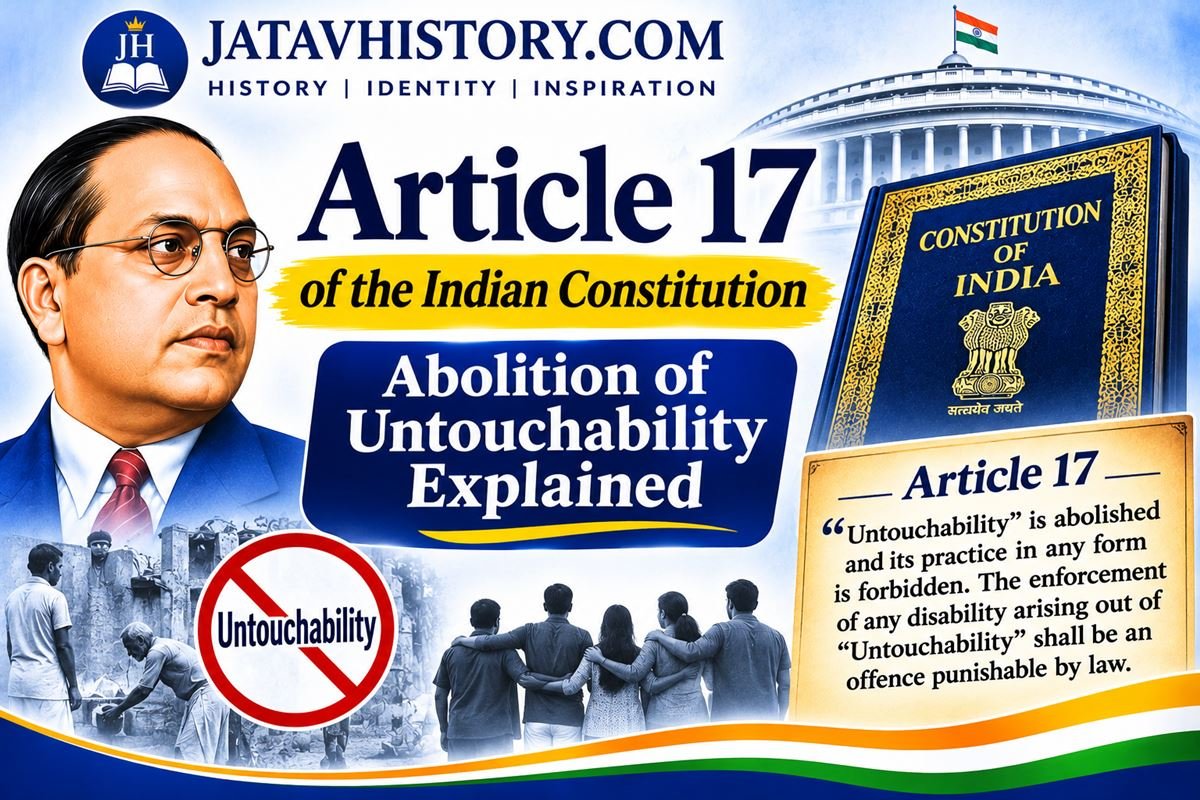
India is a country with people from different communities, religions, languages and social backgrounds. Every citizen deserves dignity and equal treatment. However, for many generations, caste-based discrimination and untouchability denied basic social rights to large sections of society.
After independence, the makers of the Indian Constitution recognised that political freedom would have little meaning without social equality. Therefore, they included important provisions to protect people from discrimination and unfair treatment.
One of these important provisions is Article 17. It clearly abolishes untouchability and makes the enforcement of disabilities arising from it punishable under law.
In this article, we will understand Article 17 of the Indian Constitution, its exact meaning, history, practical examples and the laws made to enforce this constitutional protection.
- Part: Part III – Fundamental Rights
- Subject: Abolition of Untouchability
- Constitution adopted: 26 November 1949
- Constitution came into force: 26 January 1950
- Important law: Protection of Civil Rights Act, 1955
- Another important law: SC/ST (Prevention of Atrocities) Act, 1989
What Is Article 17 of the Indian Constitution?
Article 17 is a Fundamental Right included in Part III of the Constitution of India. Its main purpose is to abolish untouchability and prohibit its practice in any form.
The Article also says that enforcing any disability arising from untouchability is an offence punishable according to law.
In simple words, no person can be treated as untouchable or denied social and civil rights on that basis. No one has the legal authority to stop another person from using public facilities or enjoying rights because of caste-based untouchability.
Article 17 is especially important in India's history because untouchability was connected with deep-rooted caste practices that denied dignity and equal opportunities to many people.
Exact Text of Article 17
The constitutional text of Article 17 is short, but its meaning is very important.
ARTICLE 17 – ABOLITION OF UNTOUCHABILITY
"Untouchability" is abolished and its practice in any form is forbidden. The enforcement of any disability arising out of "Untouchability" shall be an offence punishable in accordance with law.
This provision makes it clear that untouchability is not accepted by the Constitution. It also gives Parliament the basis to make laws that punish practices and disabilities arising from it.
What Does Abolition of Untouchability Mean?
Abolition means ending or legally removing something. Therefore, abolition of untouchability means that the practice cannot be followed or enforced in India.
Historically, untouchability involved treating certain communities as socially inferior and restricting their access to common facilities, public places and social activities.
People affected by such practices could face restrictions in entering places of worship, using public water sources, accessing shops, receiving services or participating in community life.
Article 17 rejects this type of treatment. It supports the principle that every person deserves dignity and equal access to rights protected by law.
Why Was Article 17 Included in the Constitution?
Untouchability was a serious social problem in Indian society. It affected the everyday lives of people belonging to communities that faced caste-based exclusion.
Social discrimination could affect education, employment, access to public places, religious activities and basic human dignity.
The makers of the Constitution wanted independent India to follow democratic values and equal citizenship. They understood that a country could not build a fair society while allowing untouchability to continue.
Article 17 was therefore included as a direct constitutional prohibition. Unlike some constitutional principles that mainly guide government policy, Article 17 has a clear prohibition and provides for punishment according to law.
History of Article 17
Article 17 was discussed during the preparation of the Constitution in the Constituent Assembly. It was originally Draft Article 11.
The Draft Article was debated on 29 November 1948. Members discussed the importance of ending untouchability and the need to make its practice punishable.
The provision was accepted by the Constituent Assembly and became Article 17 in the Constitution. The Constitution was adopted on 26 November 1949 and came into force on 26 January 1950.
Article 17 was an important step in the constitutional effort to end caste-based exclusion and establish equal citizenship.
Read our related article: Constitution Day: History and Importance of 26 November .
Examples of Practices Prohibited Under Article 17
Article 17 prohibits untouchability in every form. The Protection of Civil Rights Act, 1955 explains several specific disabilities and practices that can attract legal consequences when based on untouchability.
Examples include:
- Denying a person entry into a public place of worship on the ground of untouchability.
- Preventing someone from using a public water source because of caste.
- Denying access to a public shop, restaurant, hotel or place of entertainment on this ground.
- Refusing admission to a hospital or educational institution because of untouchability.
- Refusing to sell goods or provide services on this prohibited ground.
- Imposing social restrictions or boycotts because a person exercises rights protected by the law.
- Forcing a person to perform certain degrading work on the ground of untouchability.
These examples help explain how constitutional protection works in everyday situations. The exact legal offence and applicable punishment depend on the facts and the relevant law.
Which Law Enforces Article 17?
Article 17 provides the constitutional prohibition. Parliament has enacted laws to make this protection effective and punish offences connected with untouchability.
Two important laws in this area are the Protection of Civil Rights Act, 1955 and the Scheduled Castes and Scheduled Tribes (Prevention of Atrocities) Act, 1989.
1. Protection of Civil Rights Act, 1955
The Protection of Civil Rights Act, 1955 is an important law enacted to prescribe punishment for the preaching and practice of untouchability and for enforcing disabilities arising from it.
It was originally known as the Untouchability (Offences) Act, 1955. It was amended in 1976 and renamed the Protection of Civil Rights Act.
The Act deals with different forms of discrimination based on untouchability. Its provisions cover matters such as access to places of worship, public facilities, shops, services and educational or medical institutions.
It also contains provisions dealing with offences, penalties and responsibilities of authorities.
Official law: Protection of Civil Rights Act, 1955 – India Code .
2. SC/ST (Prevention of Atrocities) Act, 1989
The Scheduled Castes and Scheduled Tribes (Prevention of Atrocities) Act, 1989 is another important law that protects members of Scheduled Castes and Scheduled Tribes against specified offences and atrocities.
The Act provides for punishment for offences listed under its provisions. It also contains arrangements relating to special courts, protection of victims and witnesses and other legal safeguards.
This Act is separate from the Protection of Civil Rights Act. Both laws have different provisions and should not be treated as the same law.
Official information: India Code – Government of India .
What Is the Punishment Under Article 17?
Article 17 itself states that enforcing any disability arising from untouchability shall be an offence punishable in accordance with law. It does not provide a single separate punishment for every possible situation.
The punishment depends on the applicable law and the nature of the offence.
The Protection of Civil Rights Act, 1955 contains provisions for punishment for different offences connected with untouchability. The punishment can include imprisonment and fine, depending on the particular provision.
Other applicable laws may also be relevant depending on the facts. For example, where a specified offence against a member of an SC or ST community is committed, provisions of the SC/ST (Prevention of Atrocities) Act may apply if the legal requirements are met.
Therefore, it is not correct to assume that every incident of caste discrimination automatically carries the same punishment under Article 17.
Difference Between Article 17 and the Protection of Civil Rights Act
Many people use these two names together, but they are not the same thing.
| Point | Article 17 | PCR Act, 1955 |
|---|---|---|
| Nature | Constitutional provision | Parliamentary law |
| Purpose | Abolishes untouchability | Prescribes punishment for offences connected with untouchability |
| Location | Part III of the Constitution | Separate Act of Parliament |
| Year | 1950, when the Constitution came into force | 1955 |
| Role | Creates the constitutional prohibition | Provides detailed legal provisions and penalties |
Role of Dr. B. R. Ambedkar in the Fight Against Untouchability
Dr. B. R. Ambedkar was one of the most important social reformers and constitutional thinkers in modern Indian history. He spent much of his public life fighting caste discrimination and untouchability.
He believed that every human being deserved dignity, education and equal opportunities. He challenged social practices that treated people as inferior because of their caste.
Ambedkar also played a leading role in the making of the Constitution as Chairman of the Drafting Committee. The constitutional abolition of untouchability was an important part of the new democratic framework.
His work and ideas continue to be important in discussions about equality, social justice and constitutional rights.
Read more: Dr. B. R. Ambedkar's Role in Making the Indian Constitution .
How Does Article 17 Support Equality?
Article 17 is directly connected with the constitutional promise of equality and dignity. It rejects the idea that one person can be treated as socially inferior because of caste.
Article 14 provides equality before the law and equal protection of laws. Article 15 prohibits discrimination on specified grounds. Article 17 specifically abolishes untouchability.
Together, these provisions form an important part of the constitutional framework for equality and protection against discrimination.
The Preamble also speaks about justice, liberty, equality and fraternity. These values explain why ending untouchability is important for Indian democracy.
Related reading: Preamble of the Indian Constitution: Meaning and Importance .
What Should a Person Do If They Face Untouchability?
If someone faces a restriction or disability because of untouchability, it is important to understand the facts and seek appropriate legal assistance.
Some general steps may include:
- Note the date, time and place of the incident.
- Keep any available messages, documents, photographs or other relevant evidence.
- Note the names of people involved and possible witnesses, if it is safe to do so.
- Approach the local police station where the facts disclose a possible criminal offence.
- Seek help from the District Legal Services Authority for information about legal aid.
- Contact the relevant authorities or commissions where appropriate.
The correct legal route depends on the nature of the incident. A lawyer or legal aid authority can help identify the provisions that apply.
This article provides general educational information and is not a substitute for legal advice in an individual case.
Is Article 17 Still Important Today?
Yes. Article 17 remains important because constitutional equality must be protected not only in law but also in everyday life.
Even after decades of constitutional protection, discrimination and exclusion can still be reported in different parts of society. Awareness of legal rights helps people understand that such practices are not acceptable under the Constitution.
Schools, colleges, public institutions and communities can play an important role by promoting equal treatment and respect for every person.
The real value of Article 17 is achieved when people are able to enjoy their rights without fear, humiliation or caste-based restrictions.
Frequently Asked Questions About Article 17
1. What is Article 17 of the Indian Constitution?
Article 17 abolishes untouchability and forbids its practice in any form. It also makes the enforcement of disabilities arising from untouchability punishable according to law.
2. What is the meaning of Article 17 in simple words?
In simple words, Article 17 means that no person can be treated as untouchable or denied rights because of caste-based untouchability.
3. Which Fundamental Right is Article 17?
Article 17 is included in Part III of the Indian Constitution under Fundamental Rights.
4. When did Article 17 come into force?
Article 17 came into force on 26 January 1950, when the Constitution of India became effective.
5. Which Act was made to enforce Article 17?
The Protection of Civil Rights Act, 1955 was enacted to prescribe punishment for the practice of untouchability and the enforcement of disabilities arising from it.
6. What is the punishment under Article 17?
Article 17 makes enforcement of disabilities arising from untouchability punishable according to law. The applicable punishment depends on the relevant legal provision and facts.
7. Who fought against untouchability in India?
Dr. B. R. Ambedkar was one of the leading figures who fought against untouchability and caste discrimination. Many other social reformers and organisations also worked against these practices.
8. Is the Protection of Civil Rights Act the same as the SC/ST Act?
No. The Protection of Civil Rights Act, 1955 and the SC/ST (Prevention of Atrocities) Act, 1989 are separate laws with different provisions.
9. Does Article 17 prohibit caste-based untouchability in public places?
Yes. Article 17 abolishes untouchability and forbids its practice in any form. The Protection of Civil Rights Act contains specific provisions concerning access to public places and services.
10. Why is Article 17 important for Scheduled Castes?
Article 17 is important because it provides a constitutional prohibition against untouchability, a practice historically used to exclude and discriminate against communities.
Conclusion
Article 17 is one of the most important provisions of the Indian Constitution because it directly rejects untouchability. It makes clear that no person should be denied dignity or civil rights through caste-based practices.
The Protection of Civil Rights Act, 1955 provides legal provisions to deal with offences arising from untouchability. The SC/ST (Prevention of Atrocities) Act, 1989 provides additional protection against specified offences targeting SC/ST communities.
However, laws alone cannot create a society based on equality. Awareness, education and respect for human dignity are equally important.
Understanding Article 17 helps every citizen recognise that untouchability has no place in a democratic India. Equality and dignity should be respected in every part of society.
Official Sources and Further Reading
Explore More About the Indian Constitution
Read our other articles to understand the Constitution, Fundamental Rights and constitutional safeguards.
- Constitution Day: History and Importance of 26 November
- Dr. B. R. Ambedkar's Role in Making the Indian Constitution
- Preamble of the Indian Constitution
- Six Fundamental Rights in India
- Reservation in the Indian Constitution
- Article 341: Recognition of Scheduled Castes
- Constitutional Safeguards for SC and ST Communities
- How Was the Indian Constitution Written?
- Constitution Day Speech and Essay in English