
 as

Jatav History in Historical Newspapers: How to Search and Verify Reports
Learn how to search newspaper archives for Jatav history, verify dates and context, and cite historic reports responsibly.
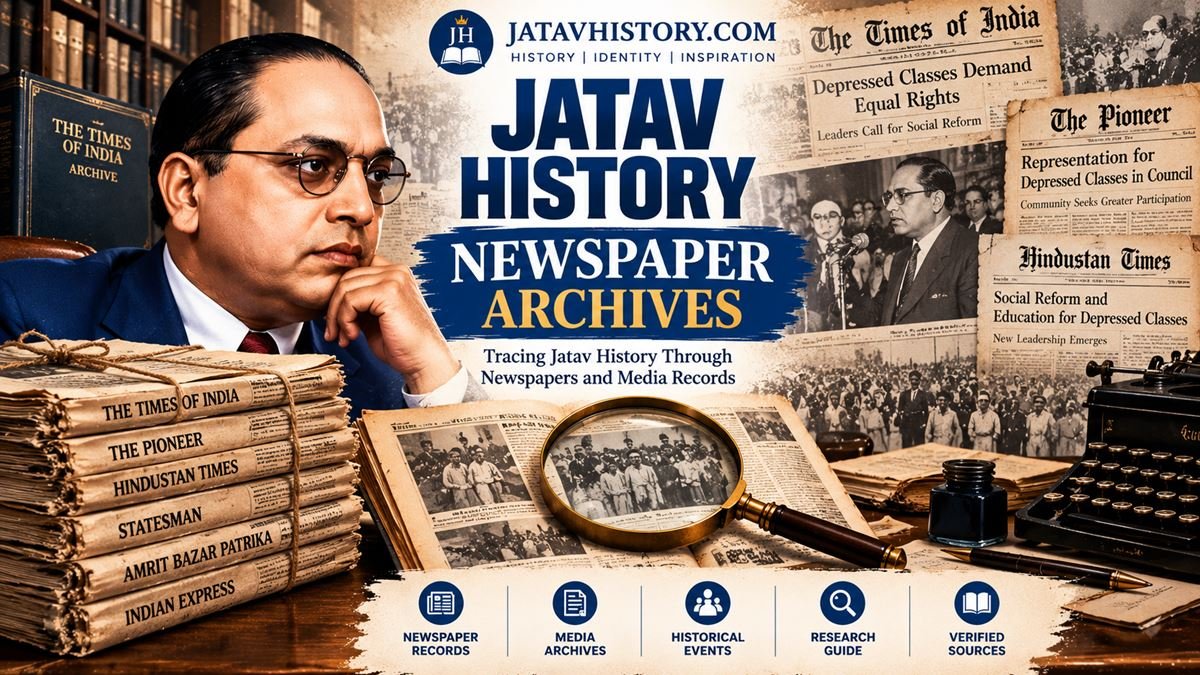
This guide explains a systematic newspaper research workflow. Archive availability and digitisation vary, and the absence of a search result does not prove that an event never occurred.
Search spelling and terminology variants
Try Jatav, Jatava and spelling variants found in the period being researched. Older newspapers may use historical or administrative terms that differ from current usage. Explain the terminology rather than silently modernising a quotation.

Search by place, date and person
Combine a name or community term with a town, district, institution, event or approximate year. Search short date ranges when possible; broad searches often return irrelevant results.
Check the full page
Read the article rather than relying on a headline or snippet. Note whether it is a news report, editorial, advertisement, letter or reprinted story. Check adjacent columns and page headings for context.
Record a complete citation
Save newspaper title, publication place if known, date, page number, article headline, archive name and a stable link or identifier. If a scan has no page number, record the archive’s item identifier.
Understand limitations
Newspaper coverage is selective. Some publications are missing, OCR may misread names and some communities were described through biased language. Treat silence in an archive cautiously and corroborate major claims elsewhere.
Organise your archive research
Maintain a spreadsheet with search terms, date ranges, results, citation details and notes. This prevents duplicate work and helps another reader reproduce the search.
Frequently Asked Questions
Does no newspaper result mean an event did not happen?
No. The newspaper may not be digitised, indexed, preserved or searchable under the term you tried.
Can OCR text be trusted?
Use it to locate a page, then verify names and quotations against the scanned image.
How should offensive historical wording be handled?
Quote only when necessary for analysis, explain the historical context and avoid repeating harmful wording gratuitously.
Sources and Further Reading
Use these official and research portals as starting points. Search for the specific document or publication that supports each claim; a portal homepage alone does not verify a particular statement.
- Ministry of Social Justice and Empowerment — official policies and publications.
- India Code — legislation and legal texts.
- National Archives of India — archival research starting point.
- Google Books — discover digitised books and bibliographies; verify the edition and page.
Editorial note: This guide explains research methods and does not claim that every historical detail has been independently established here. Add direct citations to specific records before publishing any precise date, statistic or attribution.

Written by Himanshu Singh
JatavHistory.com shares educational resources on Jatav and Dalit history, with an emphasis on source-checking, historical context and respectful representation.