
 as

Jatav History: Historical Sources, Records and Research Methods
A practical guide to researching Jatav history through archival records, gazetteers, census publications, newspapers, oral histories and academic studies.
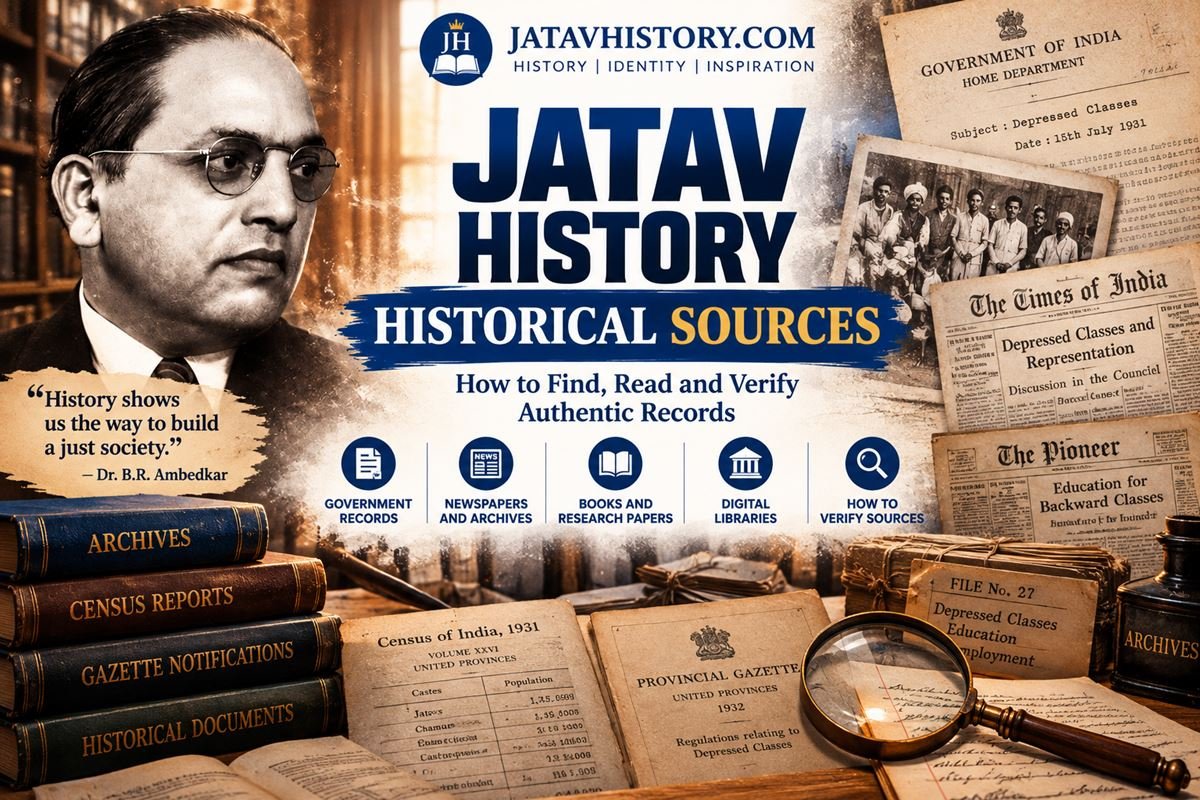
This guide gives readers a repeatable process for finding, evaluating and citing historical material while making the limits of each source clear.
Start with a focused research question
Instead of searching only for “Jatav history,” define a period, place, person, institution or event. A focused question makes it easier to choose useful records and distinguish relevant evidence from unrelated results.

Government records and gazetteers
District gazetteers, census reports, official notifications and administrative publications can help establish what an office recorded at a particular time. Their terminology may reflect colonial or administrative assumptions; quote it with context rather than treating it as a timeless description.
Newspapers and periodicals
Contemporary reports can establish that an event was reported, but newspaper accounts may contain errors or editorial bias. Record the newspaper title, date, page, headline and stable archive link whenever available.
Academic books and research papers
Use bibliographies to discover earlier work. Capture author, title, publisher or journal, year, page range and DOI or repository link where available. Read the cited passage rather than relying only on a search snippet.
Oral histories and family papers
Ask permission, record the narrator’s relationship to the event and distinguish direct memory from stories heard from others. Family letters, certificates and photographs can be valuable when their date and provenance are known.
A simple source log
For every source, save the citation, URL or archive reference, access date, key passage, claim it supports and any limitations. This makes fact-checking and future corrections much easier.
Frequently Asked Questions
Are census reports reliable?
They can be useful records of how administrators counted or classified people, but categories, coverage and methods must be understood in context.
Should every article have a source list?
For historical claims, yes. A concise list of relevant, traceable sources helps readers check the article.
Can a search result snippet be cited as proof?
Prefer the original document or full publication. Snippets may omit context or display incomplete text.
Sources and Further Reading
Use these official and research portals as starting points. Search for the specific document or publication that supports each claim; a portal homepage alone does not verify a particular statement.
- Ministry of Social Justice and Empowerment — official policies and publications.
- India Code — legislation and legal texts.
- National Archives of India — archival research starting point.
- Google Books — discover digitised books and bibliographies; verify the edition and page.
Editorial note: This guide explains research methods and does not claim that every historical detail has been independently established here. Add direct citations to specific records before publishing any precise date, statistic or attribution.

Written by Himanshu Singh
JatavHistory.com shares educational resources on Jatav and Dalit history, with an emphasis on source-checking, historical context and respectful representation.