
 as

Jatav History: Facts, Popular Claims and Historical Evidence
Learn a practical method for checking claims about Jatav history, separating documented facts, oral traditions, interpretations and unresolved questions.
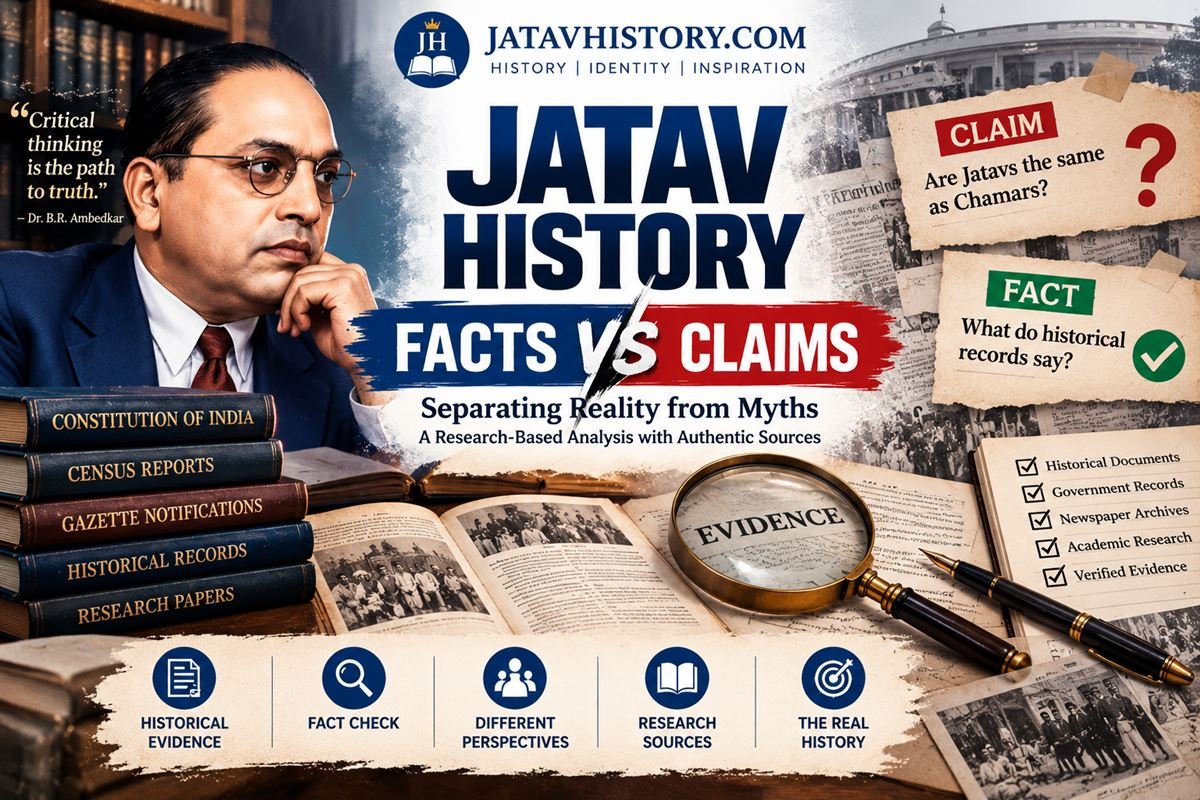
The goal of fact-checking is not to dismiss community memory. It is to describe evidence honestly, preserve context and avoid repeating a claim as established fact before it has been verified.
Four useful evidence labels
Documented fact: supported by a traceable record. Scholarly interpretation: an explanation argued from evidence. Oral or community tradition: a story or memory passed through people. Unverified claim: a statement for which adequate supporting evidence has not yet been located. These labels make uncertainty visible.

Check provenance and context
For a document, identify the author or issuing body, date, intended audience, original wording and context. A screenshot without a date or source link is difficult to verify. Translations and extracts should be checked against the original where possible.
Use independent corroboration
For consequential claims, seek another independent source. Several websites copying the same unsourced paragraph do not constitute several independent sources. Trace citations back to the earliest available record.
Watch for anachronism
Community names, administrative categories and spellings can change over time. Do not automatically apply a present-day identity label to an older record without explaining the terminology and limits.
Publish corrections transparently
If stronger evidence changes an article, update the claim, note the correction where appropriate and retain a clear source trail. Accuracy and transparency build trust more effectively than overstated certainty.
Frequently Asked Questions
Does an old source prove every statement it contains?
No. Historical sources have authors, purposes and limitations. Evaluate what a source can actually establish.
Are community traditions historical evidence?
They are evidence of memory and tradition, and may guide further research. Specific factual claims may need corroboration.
How many sources are enough?
There is no fixed number. Source quality, independence and relevance matter more than a simple count.
Sources and Further Reading
Use these official and research portals as starting points. Search for the specific document or publication that supports each claim; a portal homepage alone does not verify a particular statement.
- Ministry of Social Justice and Empowerment — official policies and publications.
- India Code — legislation and legal texts.
- National Archives of India — archival research starting point.
- Google Books — discover digitised books and bibliographies; verify the edition and page.
Editorial note: This guide explains research methods and does not claim that every historical detail has been independently established here. Add direct citations to specific records before publishing any precise date, statistic or attribution.

Written by Himanshu Singh
JatavHistory.com shares educational resources on Jatav and Dalit history, with an emphasis on source-checking, historical context and respectful representation.